Hotel Booking Engine vs OTA: True Cost Comparison for 2026
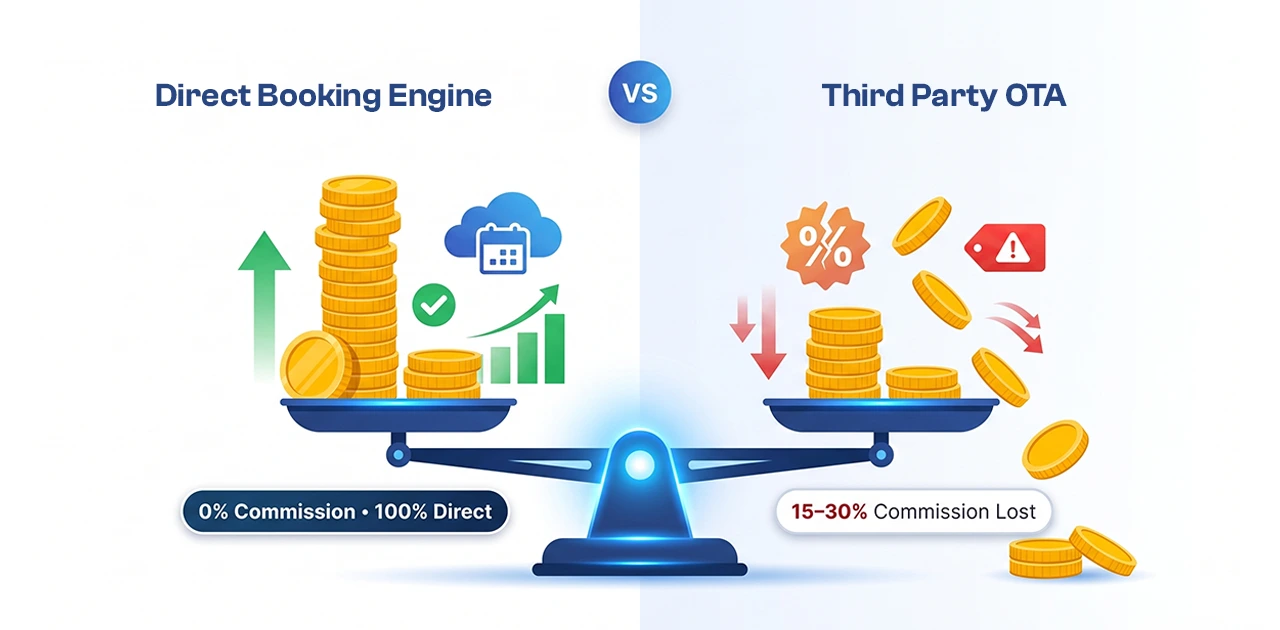
OTA vs direct booking cost comparison: A booking engine typically costs $30–$150/month. OTAs charge 15–25% commission per booking. For a 40-room hotel at 60% occupancy and $80 ADR, OTAs cost ~$140,000/year while a booking engine costs ~$1,200/year. Shifting 20% of OTA bookings direct saves $28,000 annually — the booking engine pays for itself in 5 days.
If you accept bookings through Booking.com, Expedia, or Agoda, you're paying 15–25% of every reservation's value in commission. That cost compounds fast — especially if OTAs make up most of your bookings. But before you invest in a hotel booking engine, you need to know the real numbers: does a booking engine save more than it costs?
This guide breaks down the actual cost of OTA bookings vs direct bookings with worked math, platform-specific commission rates (with sources), and the hidden costs of OTA dependency that go beyond the commission percentage.
What You Actually Pay OTAs (Platform-by-Platform)
OTA commission rates vary by platform, participation tier, and property size. Here's what properties actually pay in 2026:
Booking.com
- Standard tier: 15% base commission [1]
- Preferred Partner: 18% commission [1]
- Preferred Partner Plus: 23% commission (adds visibility + insurance) [1]
- Genius program: additional 2–10% discounts paid by property [1]
Expedia (including Hotels.com, Vrbo)
- Standard commission: 15–25% depending on contract [2]
- Expedia Collect: typically 18–22% [2]
- Hotels.com: 15–20% (same parent company as Expedia) [2]
Airbnb
- Host-only commission: 15–15.5% (most common for hotels) [3]
- Combined model: 3% host + 12–15% guest service fee (rare for hotel properties) [3]
Agoda
Regional OTAs
The average hotel pays 18–20% per OTA booking when you factor in participation in visibility programs (Preferred Partner, Genius, etc.). That's the baseline for our cost comparison.
What a Booking Engine Costs
Hotel booking engines come in three pricing models:
1. Subscription-based (most common)
- Entry-level: $30–$50/month (basic booking form, 1 property)
- Mid-tier: $80–$150/month (multi-property, advanced features)
- Enterprise: $200–$500/month (white-label, custom integrations)
These are flat monthly fees with 0% commission. The monthly cost is the total cost.
2. Commission-based booking engines
- Some vendors charge 1–5% commission per booking instead of a flat fee
- Usually marketed as "pay only when you get bookings"
- Total cost depends on booking volume — can exceed flat subscription at high volume
3. Included with PMS Many modern hotel property management systems include a booking engine at no additional charge. The booking engine is bundled into the PMS subscription. EloPMS's booking engine works this way — commission-free, no separate monthly fee.
Setup and integration costs Cloud-based booking engines integrated with your PMS typically have zero setup fees. Installation is configuration, not custom development. If you already use a cloud PMS, adding a booking engine is usually a one-click activation.
For this comparison, we'll use $100/month as the booking engine cost — a realistic mid-tier subscription that covers most properties under 100 rooms.
The Math: Side-by-Side Comparison
Let's compare the annual cost of OTA bookings vs a booking engine using realistic numbers for a mid-sized property.
Scenario assumptions:
- 40-room hotel
- 60% average annual occupancy (24 rooms occupied per night on average)
- $80 average daily rate (ADR)
- 365 nights per year
- 50% of bookings currently come from OTAs (the other 50% are direct phone/walk-in)
Total bookings per year:
- 24 rooms occupied × 365 nights = 8,760 room nights sold per year
Revenue:
- 8,760 room nights × $80 ADR = $700,800 annual room revenue
OTA bookings (50% share):
- 8,760 room nights × 50% = 4,380 OTA bookings
- 4,380 × $80 = $350,400 OTA-sourced revenue
OTA commission cost (at 20% average rate):
- $350,400 × 20% = $70,080 per year paid to OTAs
Booking engine cost:
- $100/month × 12 months = $1,200 per year
Net cost difference:
- OTAs: $70,080/year
- Booking engine: $1,200/year
- Potential savings: $68,880/year (if you shifted 100% of OTA bookings direct)
Realistic Scenario: Shift 20% of OTA Bookings Direct
You won't eliminate OTA bookings overnight. A realistic first-year goal is to shift 20% of current OTA bookings to your direct booking engine by improving your website, investing in a booking engine, and retargeting guests who found you on OTAs.
If you shift 20% of OTA bookings direct:
- 4,380 OTA bookings × 20% = 876 bookings shift from OTA to direct
- 876 bookings × $80 ADR × 20% commission = $14,016 saved in OTA commissions
Net first-year savings:
- $14,016 saved in commissions − $1,200 booking engine cost = $12,816 net savings in year one
Breakeven calculation:
- Booking engine cost: $1,200/year
- OTA commission per booking: $80 × 20% = $16
- Bookings needed to break even: $1,200 ÷ $16 = 75 direct bookings
- At 876 shifted bookings, the booking engine pays for itself in: (75 ÷ 876) × 365 = ~31 days
The booking engine breaks even in one month. Everything after that is pure margin recovery.
Hidden Costs of OTA Dependency (Beyond Commission)
The 20% commission is the visible cost. But OTA bookings carry six hidden costs that erode profitability and strategic control:
| Hidden Cost | Impact |
|---|---|
| Guest data loss | OTAs provide alias emails (e.g., guest12345@booking.com) — you can't email the guest to encourage repeat bookings or upsell services. You lose the customer relationship. |
| Rate parity clauses | Some OTA contracts forbid you from offering lower rates on your own website. This removes your ability to undercut OTAs with direct-booking discounts. [5] |
| Cancellation policy override | OTAs often override your cancellation policy with "free cancellation up to 24 hours before check-in" — even if your policy is stricter. This increases cancellation risk and last-minute inventory loss. |
| Brand dilution | Guests remember they "booked on Booking.com," not that they stayed at your hotel. OTAs capture brand equity — the guest's next search is "Booking.com hotels in [city]," not your hotel name. |
| Dependency risk | If an OTA changes its ranking algorithm or delists your property for a policy violation, your bookings can drop 30–50% overnight. You have no appeal mechanism and no leverage. |
| Review ownership | Reviews posted on OTAs stay on the OTA. If you leave the platform or get delisted, you lose access to years of guest feedback — even though those guests stayed at your property. |
These aren't hypothetical. Guest data loss means you can't build a repeat guest program — a repeat guest typically costs 1/5 as much to acquire as a new guest [6]. Rate parity removes your ability to compete on price with your own distributors. Cancellation overrides increase no-show exposure.
When you calculate the true cost of OTA bookings, the 20% commission is only the beginning.
What About the Billboard Effect?
OTA advocates argue that OTAs provide a "billboard effect": a guest discovers your property on Booking.com, searches your hotel name on Google, and books direct to avoid the OTA's fees or cancellation terms.
The evidence supports a limited billboard effect:
- Studies suggest 25–35% of travelers who view a hotel on an OTA subsequently search for the hotel's website [7]
- Of those, 40–50% will book direct if the price is equal or lower and the website experience is comparable [7]
The problem: The billboard effect only works if you have a booking engine to capture that traffic.
If a guest searches your hotel name, lands on your website, and finds no online booking option — or finds a clunky, non-mobile-responsive form that requires a phone call — they return to the OTA and complete the booking there. You paid for the billboard (listing fees, commission on previous bookings) but captured no value.
A booking engine converts billboard traffic into commission-free bookings. Without one, the billboard just funnels guests back to the OTA.
When OTAs Are Worth the Commission
OTAs aren't the enemy. They're a distribution channel — and sometimes the most cost-effective channel for certain bookings.
You should keep using OTAs when:
You're a new property with zero brand recognition. In your first 6–12 months, OTAs provide instant visibility to millions of travelers. The commission is the cost of customer acquisition. Once you build a base of repeat guests and local reputation, you can shift those guests direct.
You need to fill last-minute inventory. If a room will otherwise go unsold, a 20% commission is better than 100% revenue loss. Use OTAs tactically to sell distressed inventory during low season or unexpected cancellations.
You're targeting international travelers. Travelers from certain markets (e.g., China, Japan, parts of Europe) strongly prefer to book via local OTAs they trust (Ctrip, Rakuten, Booking.com). Trying to convert them to direct bookings is expensive and low-yield. Accept the commission and focus direct-booking efforts on domestic travelers.
You're geographically remote or lack destination awareness. If your property is off the beaten path and travelers don't know your town exists, OTAs help with discovery. Your goal is to use OTAs to build awareness, then convert repeat guests to direct.
The goal isn't to eliminate OTA bookings. The goal is to balance your distribution so you're not paying 20% commission on every single booking — especially bookings from repeat guests, local corporate accounts, and travelers who already know your brand.
How to Choose the Right Booking Engine
A booking engine only saves money if it actually converts visitors into bookings. A poorly designed booking engine will send guests back to OTAs in frustration.
What to look for:
Commission-free pricing. If the booking engine charges 3–5% commission, you're just replacing a 20% OTA commission with a 3–5% booking engine commission + subscription fee. The math doesn't work. Insist on 0% commission.
PMS integration. The booking engine must sync with your hotel property management system in real time. If a guest books via the booking engine but the reservation doesn't instantly appear in your PMS, you'll double-book rooms. Real-time two-way sync is non-negotiable.
Channel manager compatibility. If you use a hotel channel manager to distribute inventory to OTAs, the booking engine must connect to the channel manager. This ensures direct bookings immediately reduce OTA availability — preventing overbooking.
Mobile-responsive design. 60–70% of hotel website traffic is mobile [8]. If your booking engine doesn't work flawlessly on mobile, you'll lose half your direct bookings.
Support for your payment gateways. The booking engine must integrate with the payment processors you already use (Stripe, PayPal, local gateways). Switching payment providers to accommodate a booking engine adds cost and complexity.
Zero technical setup. Cloud-based booking engines should activate with configuration, not custom development. If the vendor quotes a multi-week implementation timeline or charges setup fees, keep looking.
EloPMS's booking engine meets all six criteria: 0% commission, native PMS integration, channel manager sync, mobile-first design, and instant activation. It's included with the PMS at no additional fee.
Conclusion
A booking engine costs $30–$150/month. OTAs cost 15–25% of every booking. For a 40-room hotel, that's $70,000/year in OTA commissions vs $1,200/year for a booking engine — a potential $68,880 annual savings if you shift bookings direct.
You won't shift 100% of OTA bookings overnight. But if you shift just 20% of current OTA bookings to direct, you save $12,000–$14,000 in the first year — and the booking engine pays for itself in 30 days.
The hidden costs of OTA dependency — guest data loss, brand dilution, rate parity restrictions — compound that savings. Direct bookings give you the guest's email, the ability to offer targeted discounts, and control over your cancellation policy. OTA bookings give you none of that.
Next step: Calculate your actual OTA commission spend (pull last year's OTA invoices). If it's more than $1,200, the math is clear.
See EloPMS's commission-free booking engine → Read: How to stop OTA commissions (full guide) →
Sources
- Revfine — Booking.com Commission Structure: https://www.revfine.com/booking-com-commission/
- StayFi — Hotel OTA Commission Rates 2026: https://www.stayfi.com/blog/hotel-ota-commissions
- Lodgify — Airbnb Host Fees Explained: https://www.lodgify.com/blog/airbnb-fees-hosts/
- Cloudbeds — OTA Commission Guide: https://www.cloudbeds.com/articles/ota-commissions/
- SiteMinder — Hotel Rate Parity Explained: https://www.siteminder.com/r/trends-advice/distribution/rate-parity/
- Revfine — Repeat Guest Value: https://www.revfine.com/repeat-guests/
- PhocusWire — Direct Bookings vs OTA (2024 Study): https://www.phocuswire.com/Hotel-direct-bookings-vs-ota
- Think with Google — Mobile Travel Booking Trends: https://www.thinkwithgoogle.com/marketing-strategies/app-and-mobile/mobile-travel-booking-trends/