How to Reduce OTA Commissions and Drive More Direct Reservations
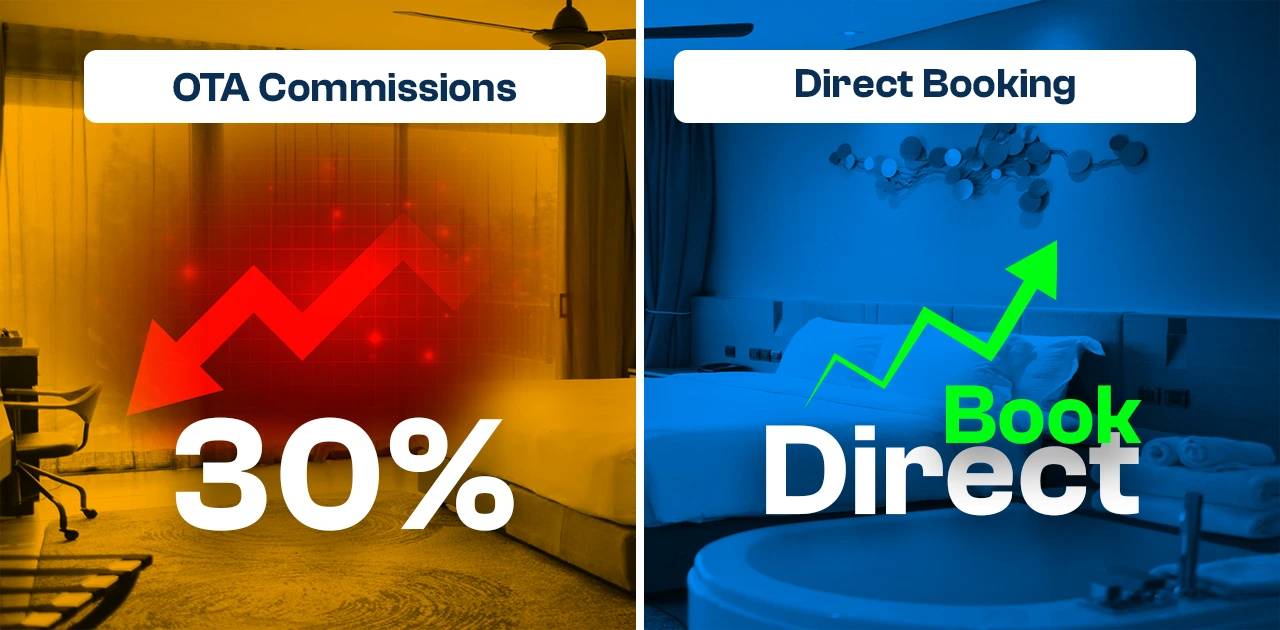
To drive more direct reservations and reduce OTA commissions, put a commission-free booking engine on your own website, give guests a reason to book direct, keep every guest's contact details, and control how many rooms each OTA sells. Keep OTAs for discovery; win repeat and name-search bookings yourself.
OTA commissions are the fee an online travel agency charges you for each reservation it delivers, usually a percentage of the booking value set in your contract. You will not, and should not, cut OTAs out entirely. But every booking you move from an OTA to your own website, phone line or WhatsApp is one you keep in full. This guide covers the steps, how to measure what commissions cost you, and an honest answer to whether a commission-free booking engine is cheaper in the long run.
What are OTA commissions?
An OTA (online travel agency) lists your hotel, takes the booking and charges you a commission on it. The rate is not one industry number: it depends on the OTA, your market, your contract, and any visibility or loyalty programme you join. Your contract, extranet and monthly commission invoices are the only reliable source for your own rate.
The commission line is not the whole cost. Look for these too:
- Rate terms in your contract. Some OTA contracts limit the rates you can offer elsewhere. Read yours before you plan direct-booking discounts.
- Guest contact data. Many OTA bookings arrive with a relay email address rather than the guest's own, which makes it hard to stay in touch after the stay.
- Programme costs. Visibility and member-discount programmes can add to what you give up per booking.
- Dependency. The more guests book through an OTA, the fewer reach your own website.
Work out what OTA commissions cost you
Before you change anything, measure it. For each OTA:
Annual commission = room revenue booked through that OTA × your contract commission rate
Then add any programme fees and payment-processing charges from your invoices. Repeat each month so you can see whether your direct share is rising.
This is OTA commission management: knowing, per channel, what each booking really nets you. In EloPMS, you set a commission percentage on each channel; it is recorded on every reservation imported from that OTA and posted to an OTA commission expense account when the folio closes. The Channel Performance and Source of Business reports then show bookings, nights and revenue for each channel next to your direct bookings.
Steps to drive more direct reservations and reduce OTA commissions
1. Put a commission-free booking engine on your website
Without a booking engine, your website is a brochure that sends people to an OTA. With one, guests can check live availability, see a real price for their dates, add extras and pay, all on your site.
Choose a booking engine that is built into your PMS, not a separate widget, so availability is always the same as the front desk's. The EloPMS booking engine reads live availability and rates from the PMS, takes online payment through Stripe, PayPal, JazzCash, EasyPaisa, Meezan Bank or HBL (connected to your own accounts), and places the booking straight on the tape chart. If you have no website, EloPMS builds one from your room and rate data, on your own domain.
2. Give guests a reason to book direct
If your website shows the same deal as the OTA, many guests will book where they started. Add something that costs you little:
- free breakfast, late check-out or airport pickup for direct bookings;
- a promo code for returning guests;
- a clear "book direct" message on every page.
Check your OTA contract's rate terms first. Perks and packages are often easier than a lower headline rate. In EloPMS, add-ons such as breakfast or an airport transfer can be sold in the booking flow, and rate plans can carry promo codes and sale dates.
3. Capture the guest's details, then stay in touch
Whoever made the booking, the guest is in front of you at check-in. Record their real email, phone or WhatsApp number, and preferences. Then follow up: a thank-you after check-out, an offer before the next season, a note on special dates.
EloPMS keeps one guest profile with stay history and lifetime spend, and its notifications send SMS, email and WhatsApp messages from templates, automatically on booking events or as a campaign to a list of past guests.
4. Make your own website easy to find
- Claim your Google Business Profile and link it to your booking page.
- Rank for your own name. Search "[your hotel name] [city]". If an OTA appears above your site, that search is costing you commission.
- Put a "Book now" button on every page, and make sure the site is fast on a phone.
The hotel website EloPMS generates sends search engines the property's title, description and structured data on every page, and publishes a sitemap automatically.
5. Show your direct rate where guests compare prices
Google's hotel search and metasearch sites show rates from several sellers side by side. If your own rate appears there, guests can book with you instead of an OTA. Ask your booking-engine provider which of these it can connect to, and what it costs.
6. Reward repeat guests
A simple scheme works: a discount or upgrade on the next direct stay, or perks for frequent business travellers. EloPMS lets you tag guests with VIP tiers, create member and corporate rate plans, and see your repeat-guest ratio in the reports.
7. Manage your channel mix
Use OTAs when you need reach, and hold rooms back when you don't:
- lean on OTAs in low season and for new markets;
- on dates that are filling anyway, limit or stop OTA sales;
- watch your source-of-business report monthly to see whether the direct share is growing.
In EloPMS, the rate and availability chart sets stop-sell, minimum stay and allotment caps per room type and date, and the channel manager pushes your rates and availability to connected OTAs.
What does "OTA commission-free" mean?
"Commission-free" means a booking channel that takes no percentage of each reservation: your own website's booking engine, phone, email, WhatsApp and walk-ins. It does not mean free. A direct channel has its own costs: the booking-engine software, payment-gateway fees, your website, marketing to bring guests to it, and staff time to answer enquiries. The difference is that these costs do not rise every time you sell a room.
Are commission-free booking engines actually cheaper than OTA commissions long-term?
Usually, once enough bookings come through your own site, but it depends on your numbers. Compare these two lines for a year:
| Line | What goes in it | Where to find it |
|---|---|---|
| Cost of the direct channel | Booking-engine or PMS share, payment-gateway fees, website and domain, marketing, staff time | Your quotes and invoices |
| Commission avoided | Commission you would have paid on the direct bookings that would otherwise have come through an OTA | Your direct booking revenue × your OTA commission rate |
Two honest cautions:
- Not every direct booking is a saved commission. Some guests would have booked direct anyway. Count the bookings you actually moved.
- A booking engine with no traffic saves nothing. The engine only pays off with the steps above: a reason to book direct, a website people can find, and repeat-guest follow-up.
For a property that already sells rooms online and has a website, the direct channel's costs are largely fixed while commission grows with every OTA booking, so moving bookings direct tends to get cheaper as volume grows. Run the comparison with your own figures before you decide. For more, see hotel booking engine vs OTA.
Options for direct guest bookings that reduce OTA fees
- A booking engine on your website, linked to your PMS so availability is always right.
- Phone, email and WhatsApp reservations keyed straight into the PMS, with a deposit link where possible.
- Your Google Business Profile, linking to your booking page.
- Corporate and travel-agent agreements billed to the company account. EloPMS handles negotiated rate plans and company billing through its city ledger.
- Repeat-guest offers sent to past guests by email, SMS or WhatsApp.
How a booking engine works with your PMS and channel manager
- The guest picks dates and party size on your website; the engine shows only room types that are free for those dates and can hold that many guests.
- Each room shows a price for the whole stay, from your rate plans.
- The guest adds extras, enters their details and pays online, or the booking is held as tentative for the front desk to arrange payment.
- When the payment succeeds, the booking is confirmed and appears in the PMS, with the deposit recorded.
- The room comes off your sellable inventory, and your next availability update to the OTAs reflects it.
When the booking engine, PMS and channel manager are one system, there is no gap between them to reconcile. That is how EloPMS is built.
Why you shouldn't leave OTAs entirely
OTAs bring guests who have never heard of you, especially international travellers and visitors to a new property. Research from Cornell University's School of Hotel Administration described a "billboard effect": travellers find a hotel on an OTA, then search for it by name and book on the hotel's own site. Being listed helps you be found; your website, offers and follow-up then decide where the booking lands.
The goal is not zero OTA bookings. It is a mix where OTAs fill the gaps and your own channels win repeat guests and people already searching your name.
What to look for in a hotel booking engine
- No per-booking commission
- Live availability from your PMS, not a delayed copy
- Works well on phones
- Online payment through gateways your guests use
- Multi-currency display for international guests
- Add-ons, packages and promo codes
- Bookings land in the same PMS your front desk uses
- Connected to your channel manager, so all channels share one inventory
- Invoices that work with the tax system you report to
EloPMS covers this list, and it is our recommendation for independent hotels that want to shift bookings direct: booking engine, hotel website, channel manager and front desk in one system. Pricing is on request.
Start a 15-day free trial (no credit card required), or book a demo to see the booking engine, channel manager and front desk working together.
Related: how to increase hotel direct bookings · commission-free direct bookings · what is a hotel channel manager
Sources
- Anderson, Chris K., "The Billboard Effect: Online Travel Agent Impact on Non-OTA Reservation Volume," Cornell Hospitality Report, Cornell University School of Hotel Administration, 2009; and "Search, OTAs, and Online Booking: An Expanded Analysis of the Billboard Effect," Cornell Hospitality Report, 2011.