
Resort Property Management System: The Complete Guide (2026)
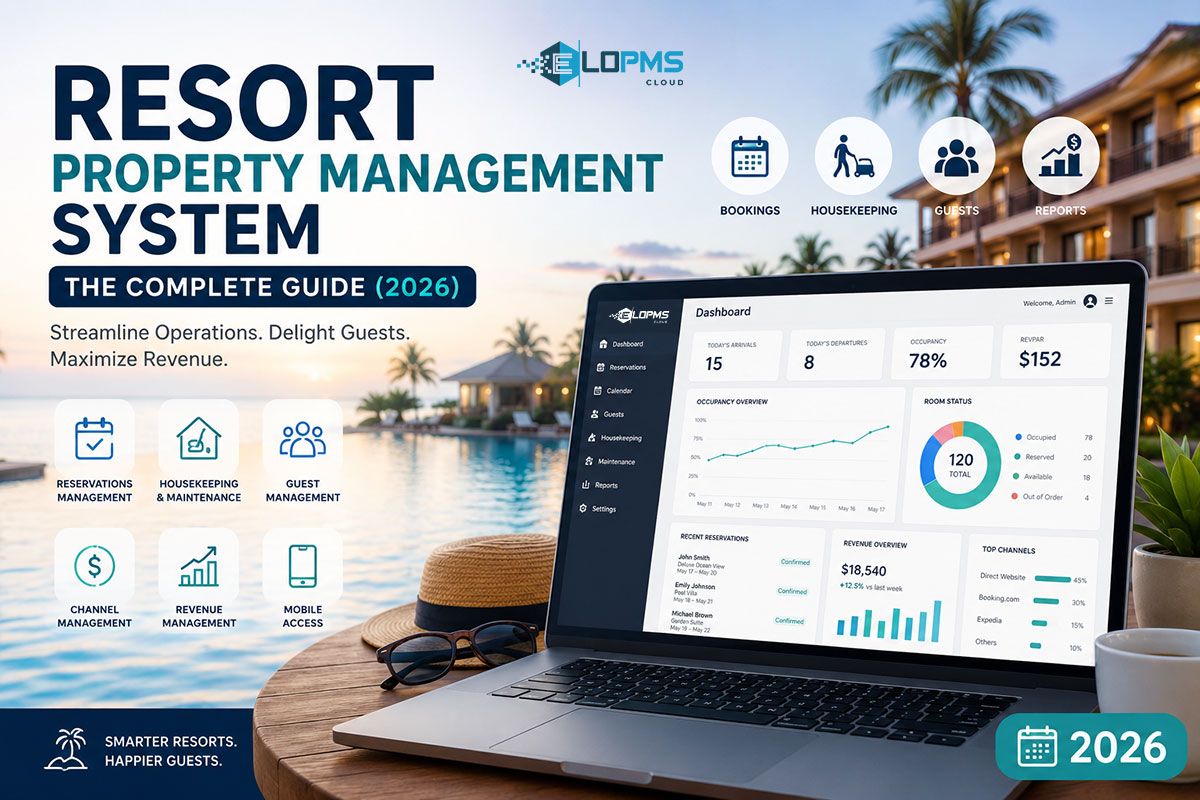
A resort property management system is specialized hotel software designed to manage multi-amenity operations including room bookings, spa appointments, activity scheduling, restaurant POS, banquet coordination, and all-inclusive package billing under one unified platform. Unlike standard hotel PMS, resort systems integrate housekeeping, F&B outlets, and guest experience modules to orchestrate complex operational workflows across multiple departments.
If you run a resort with spa services, golf, water sports, multiple dining outlets, or all-inclusive packages, you've probably realized that standard hotel PMS software doesn't fit your operations. Hotels focus on room inventory and front desk transactions. Resorts orchestrate guest journeys across multiple amenities, activities, and outlets — each requiring real-time coordination, unified billing, and comprehensive guest profiles. The wrong system creates data silos, revenue leakage, and frustrated guests.
What Is a Resort Property Management System?
A resort property management system is specialized hotel PMS software built specifically for multi-amenity destination properties. While standard hotel PMS manages room inventory, reservations, and front desk operations, resort PMS adds layers of complexity: activity scheduling (golf tee times, spa treatments, water sports, excursions), multi-outlet point-of-sale integration (restaurants, bars, spa retail, gift shops), all-inclusive package management, and comprehensive guest experience tracking.
The architectural difference is fundamental. Hotels are accommodation-focused — guests check in, sleep, check out. Resorts are destination experiences — guests stay multiple days and interact with 10+ touchpoints: dining reservations, spa appointments, activity bookings, concierge requests, beach services, entertainment, and more. Each touchpoint needs to integrate with the guest's folio, preferences, and package tier in real-time.
Resort PMS serves properties from 50 to 500+ rooms with complex operational needs. A 100-room boutique resort with spa, two restaurants, pool bar, and water sports has more operational complexity than a 200-room business hotel with one restaurant. The resort needs activity calendars, therapist scheduling, equipment rental tracking, package inclusion enforcement, and multi-outlet charge-to-room — capabilities standard hotel PMS either lacks or offers only through expensive third-party integrations.
Why Resorts Need Specialized PMS Software (Not Generic Hotel PMS)
Multi-Amenity Coordination
Resorts operate multiple revenue centers simultaneously: spa, golf course, water sports center, multiple restaurants, bars, entertainment venues, retail shops, and activity desks. Each amenity needs real-time availability calendars, staff scheduling, equipment tracking, and seamless integration with guest folios. A guest books a 2 PM spa treatment, 7 PM dinner reservation, and tomorrow's snorkeling trip — all three systems must sync with their room profile and package tier instantly.
Standard hotel PMS treats these as separate systems requiring manual coordination. Resort PMS unifies them. The spa receptionist sees the guest's package tier and knows their massage is included in their AI+ package. The restaurant host sees their dietary preferences from check-in. The water sports desk charges premium scuba equipment but includes snorkeling gear based on package rules automatically.
All-Inclusive and Package Management
All-inclusive resort software is critical for properties offering bundled pricing where accommodation, meals, drinks, and activities are included in the upfront rate. Package management goes beyond simple bundling — it enforces tier-specific inclusions (standard AI vs AI+ vs AI Gold), tracks consumption against package costs, prevents revenue leakage from unbilled premium services, and optimizes upsell opportunities.
Manual package tracking creates revenue bleeding. A bartender gives premium vodka to a standard AI guest entitled to house brand only — costing the resort $10-20 per pour. In a 100-room all-inclusive resort at 80% occupancy serving 160 guests daily, even 20 premium-pour errors at $15 each costs $300/day or $9,000 monthly. All-inclusive resorts face significant F&B cost control challenges, making package enforcement critical. Resort PMS flags premium items at point-of-sale and enforces package rules automatically. The system knows which drinks, dining venues, and activities are included versus charged for each package tier.
Package tier upgrades are revenue opportunities. A guest on standard AI might pay $200 to upgrade to AI+ for premium dining access and top-shelf liquor. Front desk staff often forget to offer upgrades at check-in. Resort PMS prompts upsell opportunities automatically and allows mid-stay upgrades with prorated pricing.
Non-Room Revenue Tracking
Resorts generate significantly more non-room revenue than traditional hotels — nearly 50% of total revenue comes from sources outside rooms including food and beverage, spa treatments, activities, retail, and entertainment, while hotels typically rely more heavily on room revenue. This revenue mix fundamentally changes operational priorities and system requirements.
Resort PMS must track revenue by outlet, integrate POS across all locations, support charge-to-room from every revenue center, and provide consolidated reporting that breaks down profitability by department. Standard hotel PMS treats F&B as optional add-on modules or requires separate restaurant POS with manual reconciliation at night audit.
The multi-outlet restaurant POS integration is non-negotiable for resorts. Guests expect to charge pool bar drinks, beachside lunch, spa retail, and golf pro shop purchases directly to their room. Each transaction must update the guest folio in real-time, respect package inclusion rules, and consolidate into a single checkout settlement.
Luxury Guest Profiles and Personalization
Resort guests expect personalized experiences based on preferences, history, and VIP status. A returning guest shouldn't have to re-explain their dietary restrictions, pillow preference, favorite wine, or anniversary date every visit. Resort PMS builds comprehensive guest profiles capturing preferences across all touchpoints: room type, bedding, minibar preferences, spa treatment history, dining allergies, activity interests, and special occasions.
Pre-arrival customization is expected at luxury resorts. The system should send preference questionnaires before arrival, trigger pre-arrival preparations (stock preferred wine, set room temperature, book requested spa time), and alert staff of VIP arrivals, anniversaries, or special requests automatically.
Repeat guest recognition drives loyalty. Resort PMS should flag returning guests, display their preference history to all departments, and enable personalized welcome amenities based on past stays. A guest who always orders the tuna tartare appetizer at your signature restaurant should see it recommended when they make their next reservation.
Seasonal Staffing Complexity
Resort operations scale dramatically by season. A beach resort in peak season might operate at 95% occupancy with 150 staff. Off-season drops to 40% occupancy with 60 staff. Scheduling housekeeping, F&B, activities, and spa staff across seasonal demand swings requires dynamic labor management capabilities.
Standard hotel PMS offers basic employee modules. Resort PMS needs shift scheduling by department, labor cost tracking against revenue, seasonal hiring workflows, and productivity metrics by role. When occupancy doubles for high season, you need to know exactly how many housekeepers, servers, bartenders, and activity coordinators to schedule without overstaffing or underservicing guests.
Core Features of Resort Management Software
Front Desk and Reservations
The reservation engine handles room bookings, guest profiles, group blocks, rate management, and availability calendars. Front desk modules manage check-in/check-out, room assignments, folio management, guest requests, and payment processing. Night audit automates end-of-day reconciliation, posts room charges, and rolls date forward.
Resort-specific requirements include package tier selection at booking, pre-arrival preference capture, VIP flagging, anniversary/special occasion tracking, and seamless handoff to activity and dining reservation systems. The front desk should see a unified guest timeline showing all upcoming spa appointments, dining reservations, and activity bookings.
Multi-Outlet Point-of-Sale
Every revenue center needs integrated POS: restaurants, bars, pool/beach service, spa retail, gift shops, golf pro shop, and activity desks. All outlets must support charge-to-room, enforce package inclusion rules, sync with guest folios in real-time, and consolidate into unified checkout settlement.
The kitchen display system (KDS) integrates with restaurant POS to route orders to kitchen stations automatically. The spa POS tracks therapist schedules, treatment room calendars, retail inventory, and service package redemptions. Each outlet operates independently but shares guest data and billing centrally.
Activity and Amenity Booking
Resorts offer activities requiring calendar management, equipment tracking, capacity limits, and staff scheduling: golf tee times, spa treatments, tennis courts, water sports equipment, excursions, cooking classes, fitness sessions, and entertainment events. Each activity needs availability calendars, booking rules (advance reservation windows, cancellation policies), and integration with guest profiles and package tiers.
Guest self-service booking portals let guests reserve activities via mobile app or in-room tablets before and during their stay. The system should send confirmation emails, booking reminders, and allow cancellations/rescheduling within policy limits. Staff-facing calendars show real-time availability, waitlists, and equipment assignments.
Housekeeping and Maintenance
Multi-building resort properties require sophisticated housekeeping coordination. Housekeepers need mobile access to room status, turnover priorities, special requests, and VIP notifications. The system should route tasks by building/zone, track completion times, flag inspection requirements, and sync room-ready status to front desk instantly.
Preventive maintenance scheduling is critical for resort amenities: pool equipment, golf course maintenance, water sports gear, spa equipment, and fitness machines. The maintenance module should schedule recurring tasks, track work orders, log repair history, and prevent equipment downtime through proactive servicing.
Channel Manager and Booking Engine
The hotel channel manager distributes room inventory and rates to OTAs (Booking.com, Expedia, Airbnb) and global distribution systems automatically, preventing overbookings through real-time synchronization. The booking engine enables commission-free direct bookings from your resort website at zero OTA middleman fees.
OTA commissions range from 15-30% per booking according to industry benchmarks. A 100-room resort generating 50% occupancy through OTAs pays $45,000-$90,000 monthly in commissions at $200 average daily rate. Commission-free direct bookings via an integrated booking engine shift this revenue back to the property. EloPMS includes both channel manager and booking engine built-in — competitors often charge separately for each module.
All-Inclusive Package Management
Package management defines tier structures (All-Inclusive, AI+, AI Gold, Modified American Plan, European Plan), configures which services are included versus charged in each tier, and enforces inclusion rules automatically across all outlets. The system must handle unlimited package configurations, tier-specific pricing, package upgrades (with prorated billing), and consumption tracking against package costs.
Meal plan tracking covers All-Inclusive (all meals + drinks), Modified American Plan (breakfast + dinner), European Plan (room only), and custom configurations. The POS checks package tier at every transaction and applies correct billing automatically. Guests see transparent folio tracking showing which charges are included versus add-ons.
Accounting and Reporting
Multi-outlet revenue consolidation, commission tracking, owner/investor dashboards, ADR and RevPAR by segment, department profitability analysis, and automated financial reporting are essential for resort finance teams. The accounting module should integrate with double-entry general ledger, accounts payable/receivable, payroll, inventory purchasing, and tax compliance (FBR e-invoicing for Pakistan, ZATCA Phase-2 for Saudi Arabia).
Resort-specific reporting breaks down revenue by outlet (rooms, restaurants, bars, spa, activities, retail), tracks package tier profitability, measures upsell conversion rates, and benchmarks performance against prior periods and competitive sets. Multi-property resort groups need consolidated reporting across all locations with drill-down capability.
Guest Communication
Pre-arrival messaging, in-stay request handling, concierge automation, and post-stay follow-up improve guest experience and drive direct rebooking. Automated pre-arrival emails capture preferences, offer activity booking, confirm special requests, and provide resort information. In-stay messaging via mobile app or SMS lets guests request services, book activities, and communicate with concierge without calling front desk.
Post-stay follow-up requests reviews, thanks guests, offers incentives for direct rebooking, and captures feedback for service improvement. WhatsApp integration is popular in Pakistan and GCC markets where many guests prefer messaging communication.
Resort PMS vs Hotel PMS: Key Differences
| Feature | Standard Hotel PMS | Resort PMS |
|---|---|---|
| Primary focus | Room inventory and front desk | Multi-amenity orchestration |
| Revenue sources | Rooms (70-80%), F&B (20-30%) | Rooms (40-60%), F&B + activities + spa (40-60%) |
| Activity management | Not included | Integrated (golf, spa, tours, water sports) |
| Package billing | Limited or bolt-on | Native all-inclusive engine |
| Guest journey | 1-2 nights, minimal touchpoints | Multi-day, 10+ touchpoints (dining, spa, activities) |
| Housekeeping complexity | Single building, standard procedures | Multi-building, amenity-specific workflows |
| POS integration | Optional or separate | Required (charge-to-room across outlets) |
| Seasonal operations | Minimal variance | Critical (staffing, inventory, rates scale by season) |
The fundamental distinction: hotel PMS optimizes room inventory turnover and front desk efficiency. Resort PMS orchestrates multi-day guest experiences across interconnected revenue centers. Hotels can survive with basic PMS and manual coordination. Resorts cannot — the operational complexity demands unified systems or revenue bleeds through data silos, staff errors, and missed upsell opportunities.
How EloPMS Simplifies Resort Operations
EloPMS delivers an all-in-one resort platform combining PMS, multi-outlet POS, housekeeping, accounting, activity booking, channel manager, and booking engine under single unified software. No third-party integrations, no separate vendor contracts, no data synchronization issues. One login, one dashboard, one support team.
The commission-free booking engine enables direct sales at zero OTA middleman fees. OTA commissions cost 15-30% per booking. A 100-room resort at 60% occupancy, $200 ADR, generating 30% of bookings direct versus OTA saves $16,200-$32,400 monthly (30% of 1,800 room nights × $200 × 15-30% commission avoided). The booking engine investment pays for itself in commission savings alone.
For a 40-room boutique resort in Murree, Pakistan, at 50% occupancy and PKR 25,000 ADR, shifting just 20 monthly OTA bookings to direct channel saves PKR 75,000-150,000 monthly in avoided commission fees (20 room-nights × PKR 25,000 × 15-30% commission) — PKR 900,000-1,800,000 annually.
Multi-outlet billing integrates restaurants, bars, spa, activities, and retail into unified charge-to-room capability. Guests charge pool bar drinks, spa treatments, golf fees, and gift shop purchases directly to their folio. Each transaction updates in real-time, respects package inclusion rules, and consolidates into single checkout settlement. No manual reconciliation, no checkout disputes, no revenue leakage.
Built-in compliance for regional markets eliminates third-party bolt-ons. FBR e-invoicing meets Pakistan tax authority requirements automatically. ZATCA Phase-2 integration handles Saudi Arabia's electronic invoicing mandate. Competitors rely on external integrations or lack compliance entirely — EloPMS builds it native into the platform.
The owner dashboard provides multi-property groups centralized visibility across all resort locations. See occupancy, revenue, profitability, and operational metrics for every property in one consolidated view. Centralized rate and inventory control lets head office manage pricing and availability across the portfolio while local teams handle operations.
Cloud-native architecture delivers access from anywhere, automatic updates, and zero on-premise server costs. Perfect for destination resorts in remote locations where IT infrastructure is limited. Staff access the system from mobile devices for housekeeping, F&B, and activity coordination. Owners monitor performance from home or while traveling.
See how EloPMS works for resorts like yours — book a personalized demo or start a free trial.
Top Use Cases: Resort Types That Benefit from Specialized PMS
All-inclusive resorts need package management, inclusion tracking, upsell optimization, and meal plan enforcement. The system must automatically distinguish between standard AI, AI+, and AI Gold tiers at every transaction point, prevent unbilled premium services, and optimize tier upgrade revenue.
Destination resorts orchestrate multi-day guest experiences requiring activity coordination, concierge automation, personalized itineraries, and comprehensive guest profiles. Guests stay 5-7 nights and interact with 15+ touchpoints. Every interaction should reference their preferences and package tier automatically.
Luxury resorts require VIP guest profile management, white-glove service tracking, preference history across all departments, and repeat guest recognition. The system should flag returning guests, display past preferences to spa/dining/activities staff, and trigger personalized welcome amenities based on history.
Golf resorts integrate tee-time booking, pro shop POS, restaurant dining, and membership management. Golfers book tee times via mobile app, charge pro shop purchases and post-round dining to their room, and enjoy member benefits through the loyalty program.
Spa resorts need treatment scheduling, therapist calendars, retail sales tracking, wellness package billing, and treatment history for returning guests. Therapists access schedules via mobile app, treatment rooms show real-time availability, and retail inventory integrates with POS for product recommendations.
Beach and water sports resorts manage equipment rental, water activity booking, cabana/lounger reservations, and beach service POS. Guests reserve kayaks, book scuba trips, and order beachside lunch — all charging to room and respecting package inclusions automatically.
Multi-property resort groups require centralized control, consolidated reporting, cross-property loyalty programs, and unified guest profiles. Guests staying at your Maldives resort in January and Pakistan hill station in July should have seamless profile continuity and loyalty recognition across properties.
Common Challenges Resort PMS Solves
Fragmented systems create data silos and operational friction. Many resorts cobble together separate software for PMS, restaurant POS, spa scheduling, activity booking, and accounting. Each system operates independently. Staff manually reconcile data between systems at night audit. Guest information doesn't sync — spa doesn't know about dining allergies, activities desk can't see package tier, restaurant has no room number on file. Unified resort PMS eliminates silos and creates single source of truth.
OTA commission dependency erodes profitability. Resorts relying on Booking.com, Expedia, and Airbnb for 60-80% of bookings pay 15-30% commission per reservation. A 50-room resort at 70% occupancy, $250 ADR, with 70% OTA mix pays $41,344 monthly in commissions (1,050 room nights × $250 × 70% OTA × 22.5% avg commission). Resort PMS with integrated booking engine shifts revenue to zero-commission direct channels through website booking, repeat guest programs, and email marketing automation.
Manual package billing causes revenue leakage and guest disputes. Staff tracking all-inclusive tier inclusions manually make errors constantly. A server gives premium wine to a standard AI guest entitled to house wine only — $20 lost. A spa receptionist doesn't charge a premium massage thinking it's included — $80 lost. Multiply errors across 100 daily transactions and thousands leak monthly. Automated package management enforces rules at point-of-sale, prevents unbilled services, and eliminates checkout disputes.
Housekeeping bottlenecks delay room availability. Multi-building resorts with villas, suites, and standard rooms struggle coordinating housekeeping without real-time mobile access. Housekeepers work building-by-building without knowing front desk priority (early check-ins, VIP arrivals, maintenance issues). Front desk can't see live room status and tells guests "check back in an hour" instead of texting when the room is ready. Resort PMS with mobile housekeeping updates room status instantly and enables priority-based task routing.
Seasonal staffing misalignment wastes labor costs or underserves guests. Resorts operating at 95% occupancy in peak season and 35% in low season need flexible staffing models. Over-staffing in low season inflates payroll unnecessarily. Under-staffing in peak season creates guest service failures and staff burnout. Resort PMS labor management modules track productivity metrics, forecast staffing needs based on occupancy, and optimize shift schedules by department and season.
Poor guest personalization hurts repeat business. Standard hotel PMS stores basic contact information and booking history. Resort PMS captures comprehensive preferences: spa treatment history, dining allergies and favorites, activity interests, pillow preferences, minibar customization, anniversary dates, and special requests. Returning guests expect recognition and personalization — calling front desk to re-explain dietary restrictions every visit creates friction. Resort PMS displays full preference history to every department automatically.
How to Choose the Right Resort Management System
Evaluate resort PMS systematically using this checklist:
✅ All-in-one versus best-of-breed: Does the system include PMS, POS, booking engine, channel manager, housekeeping, and accounting natively — or require third-party integrations? All-in-one eliminates integration costs, data sync issues, and multi-vendor support headaches. Best-of-breed creates complexity.
✅ Activity and amenity booking: Can guests book spa appointments, golf tee times, dining reservations, water sports, and excursions from unified interface (web, mobile app, kiosk)? Does it support capacity limits, advance booking windows, cancellation policies, and waitlists?
✅ Package management capabilities: Does it handle all-inclusive billing, meal plan tracking, tier-specific inclusion enforcement, package upgrades with prorated pricing, and consumption tracking? Or just basic "package" tagging without automated enforcement?
✅ Multi-outlet POS integration: Can guests charge restaurants, bars, spa, activities, and retail to room folio seamlessly? Does it enforce package rules at point-of-sale automatically? Are all outlets unified or separate systems requiring manual reconciliation?
✅ Cloud versus on-premise deployment: Cloud delivers remote access, automatic updates, zero server costs, and mobile capability. On-premise requires capital expenditure, manual updates, IT staff, and single-location access. Destination resorts in remote areas benefit significantly from cloud architecture.
✅ Commission-free booking engine: Does it include direct booking engine or force OTA reliance? Can you customize booking flow, offer packages, capture preferences, and integrate with channel manager for rate parity management?
✅ Regional compliance requirements: For Pakistan properties, does it support FBR e-invoicing? For Saudi Arabia, ZATCA Phase-2 integration? For Malaysia, MyInvois? Built-in compliance beats third-party bolt-ons for reliability and support.
✅ Multi-property support: If operating resort groups, does it consolidate reporting, enable centralized rate/inventory control, support cross-property loyalty programs, and maintain unified guest profiles across locations?
✅ Mobile access for staff: Can housekeeping, F&B, activities, and maintenance teams access the system via mobile devices for real-time updates, task management, and guest service?
✅ Pricing transparency: Clear per-property pricing or hidden fees? Transaction fees on bookings? Separate charges for channel manager, POS, booking engine modules? Third-party integration costs? Support and training fees?
Resort PMS Pricing: What to Expect
Resort PMS pricing typically follows per-property monthly fees ($200-$800/month for 50-200 room properties) or per-room monthly fees ($2-$8 per room per month). Pricing varies based on property size, module requirements, implementation complexity, and vendor positioning.
Hidden costs inflate total ownership expense significantly. Watch for third-party integration fees (connecting external POS, channel manager, booking engine, accounting systems), transaction fees on bookings (some vendors charge 1-3% per reservation), support charges (tiered support levels with premium pricing for 24/7 access), training fees (per-user or per-session charges), and add-on module pricing (channel manager, POS, booking engine often priced separately by competitors even when marketed as "integrated").
EloPMS offers transparent bundled pricing including PMS, POS, booking engine, channel manager, and accounting with no per-transaction fees, no third-party integration costs, and no hidden support charges. You pay one predictable monthly fee per property covering the complete platform.
ROI calculation demonstrates value quickly. Commission-free direct bookings save 15-30% per reservation. A 100-room resort at 60% occupancy, $200 ADR, shifting 20% of OTA bookings to direct channel saves $10,800-$21,600 monthly (360 room nights × $200 × 15-30% commission avoided). PMS costs $400-$800 monthly for 100-room property. Commission savings alone deliver 13-54x ROI before calculating operational efficiency gains, reduced labor costs, eliminated revenue leakage, and improved guest satisfaction driving repeat bookings.
Why Choose EloPMS for Your Resort
EloPMS resort management software delivers complete resort management in unified all-in-one platform: PMS, multi-outlet POS, booking engine, channel manager, housekeeping, accounting, and activity booking. One vendor, one contract, one login, one support team. No integration complexity, no data synchronization issues, no finger-pointing between vendors when problems arise.
Commission-free direct bookings through integrated booking engine save 15-30% per reservation versus OTA dependency. Shift revenue from Booking.com and Expedia commissions back to your resort. A 60-room property shifting 30 monthly OTA bookings to direct channel at $220 ADR saves $990-$1,980 monthly in avoided commissions — $11,880-$23,760 annually.
Built-in regional compliance includes FBR e-invoicing for Pakistan, ZATCA Phase-2 for Saudi Arabia, and MyInvois for Malaysia with no third-party integrations needed. Competitors offer compliance as bolt-ons or don't support it at all. EloPMS builds tax compliance native into the platform.
Multi-property support enables resort groups to manage all locations from one centralized dashboard. Control rates and inventory across your portfolio, view consolidated financial reporting, run cross-property loyalty programs, and maintain unified guest profiles for guests visiting multiple properties.
Cloud-native architecture provides access from anywhere, automatic software updates, zero on-premise server costs, and mobile capability for staff. Perfect for destination resorts in remote locations where IT infrastructure is limited or non-existent.
Transparent pricing with no hidden fees, no per-transaction charges, and no third-party integration costs. You pay one predictable monthly fee covering the complete platform. No surprises, no vendor lock-in, no escalating costs as you grow.
Dedicated onboarding and support includes rapid implementation, comprehensive staff training, 24/7 technical support, and ongoing optimization consulting. We don't just sell software and disappear — we partner with you for long-term success.
Ready to streamline your resort operations? Schedule a free demo to see how EloPMS handles multi-amenity management, all-inclusive billing, and commission-free direct bookings. Or start a free 14-day trial to test the platform with your team before committing.
Sources
- OTA commission rates (15-30%): StayFi OTA Fees Guide 2026 (https://stayfi.com/vrm-insider/2025/11/04/ota-fees/)
- Resort non-room revenue (nearly 50%): Thynk Cloud - How to Diversify Your Hotel's Revenue Stream for Profitability in 2025 (https://thynk.cloud/blog/diversify-revenue-stream)
- EloPMS product capabilities: brain/site-facts.md, brain/uploads/HOTEL-PMS-PRODUCT-DOCUMENTATION.md
Audit feedback (Cycle 2 - 2026-08-19)
VERDICT: FAIL (7.8/10) - One critical math error blocks approval.
CRITICAL FIX REQUIRED:
Line 94 - Math error (3x understatement): Current: "A 100-room resort generating 50% occupancy through OTAs pays $15,000-$30,000 monthly in commissions at $200 average daily rate."
Correct calculation:
- 100 rooms × 50% occupancy = 50 rooms/night
- 50 rooms × 30 days = 1,500 room nights/month
- 1,500 × $200 ADR = $300,000 monthly OTA revenue
- $300,000 × 15% = $45,000 (low end)
- $300,000 × 30% = $90,000 (high end)
Required fix: Change "$15,000-$30,000" to "$45,000-$90,000"
This is a 3x error and was missed in cycle 1 revision. Fix this single number and the draft is publish-ready (would score 8.8/10).
Optional clarity improvement:
Line 209 - Ambiguous phrasing: "shifting 20% of OTA bookings to direct channel" could mean:
- 20% of total bookings (360 room nights) ← what you calculated
- 20% of the OTA segment only (different amount)
Current calculation is internally consistent (360 × $200 × 15-30% = $10,800-$21,600) but the phrase "20% of OTA bookings" conventionally means "20% of the OTA segment" not "20% of all bookings."
Suggested rephrase: "shifting 20% of total bookings from OTA to direct channel" OR "shifting 360 room nights per month from OTA to direct"
This is minor and won't block approval once line 94 is fixed.
What's working (preserve these):
✅ All sources live and verified ✅ Source claims accurate (15-30% OTA range, nearly 50% resort non-room revenue) ✅ 6 of 8 calculations correct ✅ Zero product fabrications (all claims verified vs site-facts.md) ✅ 10 relevant internal links ✅ Brand voice 9.5/10 (zero forbidden words, 36 preferred terms) ✅ Operational depth: spa scheduling, package tier enforcement, KDS, charge-to-room workflows ✅ E-E-A-T strong: hospitality terminology, realistic use cases, balanced OTA framing