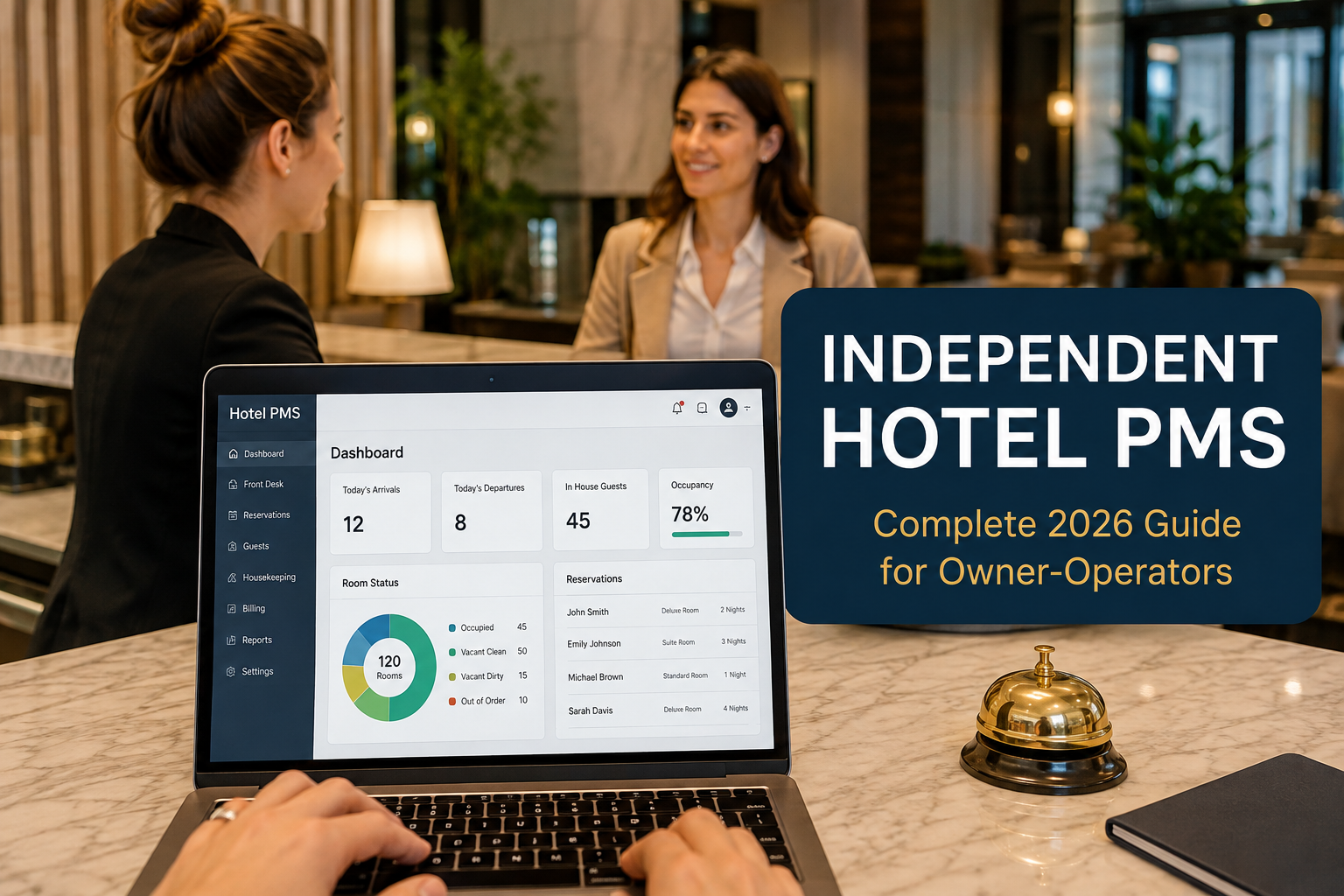
Independent Hotel PMS: Complete 2026 Guide for Owner-Operators
Independent hotels compete against chains with 10x the marketing budget and half the OTA commission rates. Your competitive edge? Agility, cost control, and the right software. Owner-operated properties need PMS that automates operations WITHOUT enterprise complexity, eliminates OTA dependency, and provides owner-centric insights — not analyst-level BI dashboards. This guide covers what independent hotel PMS actually does, how it differs from chain-focused systems, must-have features for small teams, and how to choose software that scales with your growth (not against it).
What Is Independent Hotel PMS?
Independent hotel PMS is a cloud-based property management system designed for owner-operated, non-chain hotels (typically 10–100 rooms) that prioritizes cost efficiency, commission-free direct bookings, and easy onboarding. It integrates front desk, distribution, outlet management (POS), and back-office accounting with owner-centric reporting for small teams.
An independent hotel PMS differs from chain-focused systems by emphasizing multi-role workflows (the owner often wears the GM, revenue manager, and ops lead hats simultaneously), owner dashboards that surface P&L insights at a glance, commission-free booking tools, and onboarding measured in days (1–2), not weeks.
Core modules include:
- Front desk: Reservations, folios, check-in/check-out, guest profiles, night audit automation
- Distribution: Commission-free booking engine, channel manager (OTA sync for Booking.com, Expedia, Airbnb)
- Outlets: POS for restaurant, bar, banquet with charge-to-room functionality
- Back office: Accounting (double-entry ledgers), inventory management, payroll
- Reporting: ADR (Average Daily Rate), RevPAR (Revenue per Available Room), occupancy dashboards, direct vs. OTA booking mix
Independent hotel PMS targets owner-operators, GMs of small properties, family-run hotels, and properties with 3–15 staff members total (versus 50+ staff in chain properties).
New to hotel PMS? Read our complete guide: What Is a Hotel PMS.
Why Independent Hotels Need Specialized PMS (Not Chain-Focused Systems)
Chain PMS = Over-Engineered for Small Teams
Enterprise PMS built for 50–200 room properties assumes dedicated IT staff, training departments, and multi-layer approval workflows. Independent hotels (10–50 rooms) have 3–8 staff total: owner + front desk + housekeeping. No IT team. No training budget.
Problem 1: Complexity mismatch. Complex RBAC (role-based access control) designed for large teams doesn't fit independent properties. Independent hotels need simple roles: owner (full access), front desk (reservations + check-in), housekeeping (room status), manager (reports).
Problem 2: Expensive per-room pricing. A 30-room independent hotel paying $8/room/month = $240/month. A chain PMS at $15/room = $450/month (87% more for features you don't need).
Independent Hotel Operational Realities
Owner wears multiple hats. The typical independent hotel owner serves as GM + revenue manager + marketing lead + ops troubleshooter. Software must surface insights (occupancy trends, ADR benchmarks, commission costs) without requiring a BI analyst or multi-day training course.
Tight margins = OTA commission sensitivity. Independent hotels pay 15–25% OTA commissions (source: Cloudbeds). A $100 room booked via Booking.com costs $17–25 in commission. On $10K/month room revenue, that's $2,040–3,000/month to OTAs ($24,480–36,000/year). A commission-free booking engine delivers immediate ROI.
No dedicated IT staff. Cloud PMS is non-negotiable. On-premise systems require server maintenance, backups, software updates. Independent hotels don't have IT teams for that infrastructure burden.
Small teams = training simplicity required. Staff turnover in hospitality is 70–80% annually (source: Oysterlink). Complex PMS = constant retraining costs. Drag-and-drop UI = 1–2 day onboarding.
See how EloPMS powers independent hotel operations: EloPMS for Boutique & Independent Hotels.
Essential Features in Independent Hotel PMS
1. Commission-Free Booking Engine (Highest ROI Feature)
Must-have capabilities:
- White-label booking widget (embeds on your website with your branding)
- Real-time availability sync with PMS (no overbookings)
- Zero commission on direct bookings (vs. 15–25% OTA fees)
- Mobile-optimized checkout (reduce abandonment)
- Promo codes, packages, upsells (early check-in, room upgrades)
Why it matters for independent hotels: Every $100 room booked direct vs. Booking.com saves you $17–25 in commission. A 20-room property with 50% occupancy (10 rooms/night × $120 ADR × 30 days = $36K/month revenue). If 60% comes via OTAs at 20% commission, you pay $4,320/month ($51,840/year) to OTAs. Shifting just 20% of bookings to direct = $10,368/year saved.
EloPMS edge: Integrated commission-free booking engine with brand-customizable design. No separate booking engine subscription (vs. competitors charging $100–200/month for booking engine add-on).
Learn how to cut OTA costs: How to Increase Direct Bookings Without Cutting OTAs. See EloPMS booking engine features: Booking Engine.
2. Channel Manager (Manage OTAs Without Manual Updates)
Must-have capabilities:
- Two-way sync with Booking.com, Expedia, Airbnb, Agoda (inventory + rates + reservations)
- Rate parity enforcement (prevent OTA undercutting)
- Centralized calendar (manage all channels from one screen)
- Bulk rate updates (adjust rates across all OTAs in one click)
Why it matters: You can't eliminate OTAs entirely (they drive new guest discovery), but manual updates across 5+ platforms = errors, overbookings, lost revenue. Channel manager automates sync.
See EloPMS channel manager: Channel Manager. Learn more: What Is a Hotel Channel Manager.
3. Easy-to-Use Front Desk & Reservations
Must-have capabilities:
- Drag-and-drop tape chart (visual room assignments)
- Quick check-in/check-out (minimal clicks)
- Guest profile database (track preferences, stay history)
- Folio management (itemized billing, split payments, discounts)
- Night audit automation (daily close, revenue posting, no manual reconciliation)
Why it matters: Front desk staff in independent hotels are often part-time, seasonal, or new hires. Complex PMS = training delays, errors, guest frustration. Intuitive UI = faster onboarding, fewer mistakes.
EloPMS edge: Drag-and-drop tape chart, automated night audit, 1–2 day training (vs. enterprise PMS requiring 1–2 weeks).
Explore EloPMS front desk: Front Desk & Reservations.
4. Integrated POS (If You Run Restaurant/Bar)
Must-have capabilities:
- Restaurant POS, bar POS
- Charge-to-room functionality (guests sign tabs to folio)
- Unified guest ledger ("one guest, one folio" — all charges consolidated at checkout)
- KOT/KDS integration (kitchen order tickets, kitchen display)
Why it matters: 70%+ of independent hotels run at least one F&B outlet. Disconnected POS = manual folio reconciliation, guest checkout delays, revenue leakage.
Cost comparison: Standalone POS (Square, Lightspeed, Toast) = $60–150/month subscription + integration fees. EloPMS native POS = included in PMS subscription.
EloPMS edge: Native POS with charge-to-room. No third-party integration required (vs. Cloudbeds/Mews requiring separate POS subscriptions).
Learn about EloPMS POS: Restaurant POS. Multi-outlet capabilities: Multi-Outlet Management.
5. All-in-One Back Office (Accounting, Inventory, Payroll)
Must-have capabilities:
- Double-entry accounting (auto-posting from PMS transactions)
- Inventory management (track linen, amenities, F&B stock)
- Recipe costing (for F&B outlets — calculate food cost per dish)
- HR & payroll (optional but valuable for small teams)
Why it matters for independent hotels: Cost control. Separate subscriptions = PMS ($200/mo) + accounting software ($50/mo) + inventory ($40/mo) + payroll ($60/mo) = $350/mo. All-in-one = $250–300/mo total.
EloPMS edge: Integrated accounting, inventory, payroll in one platform. No QuickBooks/Xero integration required (vs. competitors requiring third-party accounting).
Explore back office features: Accounting & Finance, Inventory & Purchasing.
6. Owner Dashboard & Reporting
Must-have capabilities:
- ADR (Average Daily Rate), RevPAR (Revenue per Available Room), occupancy dashboards
- Direct vs. OTA booking mix (track commission costs)
- Revenue by source (OTAs, direct, corporate, walk-in)
- Forecast reports (30/60/90-day occupancy projections)
- Export to Excel/PDF (for accountant, investor, lender)
Why it matters: Independent hotel owners manage P&L directly. You need revenue insights at a glance, not buried in 50-tab BI tools designed for enterprise analysts.
See EloPMS reporting: Reports & Analytics.
7. Cloud-Based & Mobile Access (Non-Negotiable)
Must-have capabilities:
- Cloud-hosted (no on-premise servers, no IT staff required)
- Mobile app for front desk, housekeeping, owner dashboard
- Accessible from anywhere (manage remotely if needed)
- Automatic updates (no manual software upgrades)
Why it matters: Independent hotel owners often manage property + family + other businesses. Cloud + mobile = check occupancy, approve discounts, review revenue from your phone.
8. Fast Onboarding & Minimal Training
Must-have capabilities:
- Intuitive UI (drag-and-drop, minimal clicks)
- Role-based access (owner, front desk, housekeeping, manager)
- Quick setup (1–4 weeks from signup to go-live)
- Training in 1–2 days (not weeks)
Why it matters: Small teams, high turnover, no dedicated trainer. Complex PMS = bottleneck. Simple PMS = fast go-live, low training costs.
How to Choose Independent Hotel PMS (Step-by-Step Buyer's Guide)
Step 1: Calculate Your Current Costs (Software + OTA Commissions)
Current software stack: PMS ($X/mo) + POS ($X/mo) + accounting ($X/mo) + booking engine ($X/mo) = total monthly cost.
OTA commission bleed: Monthly room revenue × % from OTAs × commission rate = monthly OTA cost.
Example: $30K/month revenue, 60% from OTAs, 20% avg commission = $3,600/month ($43,200/year) to OTAs.
Goal: Find all-in-one PMS with booking engine that costs LESS than current stack + reduces OTA dependency.
Step 2: Prioritize Must-Have Features
Must-have for ALL independent hotels: Booking engine, channel manager, cloud-based, mobile access, owner dashboard.
Must-have if you run F&B: Integrated POS with charge-to-room.
Must-have if you have 2+ properties: Multi-property consolidation (centralized reporting, head-office control).
Nice-to-have: Guest app, keyless entry, dynamic pricing.
Step 3: Evaluate Total Cost of Ownership (TCO)
Pricing models: Per-room/month (most common), flat monthly fee, or % of revenue.
Hidden costs: Setup fees, data migration, training, support fees, payment gateway fees.
ROI calculation: If booking engine saves $2,000/month in OTA commissions, a $400/month all-in-one PMS pays for itself 5x over.
Step 4: Test with a Live Demo (Involve Your Team)
- Request live demo (not recorded video)
- Bring front desk manager + 1–2 staff (they'll use it daily)
- Test workflows: make reservation, check in guest, charge to room, run ADR report
- Ask: How long is onboarding? What's included in support?
Step 5: Request a Free Trial
- 14–30 day trial with real reservations, real workflows
- Test on mobile (can you check occupancy from your phone?)
- Test support responsiveness (critical for small teams with no IT staff)
Ready to see EloPMS in action? Schedule a Free Demo.
Independent Hotel PMS vs. Chain PMS: Key Differences
| Feature | Chain/Enterprise PMS | Independent Hotel PMS |
|---|---|---|
| Target User | 50–200 room properties, IT teams, multi-layer approval workflows | 10–50 room properties, owner-operators, small teams (3–15 staff) |
| Onboarding | 1–2 weeks training | 1–2 days training |
| Pricing | High per-room cost ($12–20/room/month) | Affordable flat or per-room pricing ($5–10/room/month or $200–400/month flat) |
| Booking Engine | Often third-party integration; extra cost | Built-in, commission-free |
| POS Integration | Third-party (Square, Toast, Lightspeed) | Native POS with charge-to-room (EloPMS) |
| Accounting | Requires QuickBooks/Xero integration | Native double-entry accounting (EloPMS) |
| Reporting | Enterprise BI dashboards (analyst-required) | Owner dashboard (ADR, RevPAR, occupancy at a glance) |
| IT Requirements | Dedicated IT staff for on-premise systems | Cloud-native; no IT staff required |
Common Mistakes Independent Hotels Make When Choosing PMS
1. Choosing based on price alone. Cheapest PMS often lacks booking engine, POS, or accounting. Calculate TCO (total cost of ownership) + OTA savings, not just monthly subscription.
2. Ignoring OTA commission ROI. A booking engine that saves $2K/month in commissions justifies a $500/month PMS (4x ROI). Don't skip booking engine to save $100/month.
3. Overlooking mobile access. If you can't check occupancy or approve a discount from your phone, the PMS is too rigid for owner-operators.
4. Assuming all-in-one = bloated. Modern cloud PMS can be comprehensive AND easy to use. EloPMS covers front desk → POS → accounting without enterprise complexity.
5. Skipping the trial. Always test with real reservations. A PMS that looks good in a demo might be clunky in daily use.
6. Not involving front desk staff. They use the PMS 8 hours/day. If they hate it, you'll have high turnover + errors.
Top Independent Hotel PMS Options (2026)
1. EloPMS
Best for: Owner-operated independent hotels (10–100 rooms) with F&B outlets in Pakistan, GCC, global markets.
Strengths:
- All-in-one platform (PMS + booking engine + POS + accounting + inventory)
- Commission-free direct bookings (integrated booking engine with brand-customizable design)
- Native POS integration (restaurant POS, bar, banquet billing with charge-to-room)
- FBR/ZATCA compliance (built-in e-invoicing for Pakistan and Saudi Arabia)
- Owner dashboard (ADR, RevPAR, occupancy, direct vs. OTA mix at a glance)
- Multi-property support (consolidate 2–10 properties with centralized reporting)
- Fast onboarding (1–2 day training)
Pricing: Contact sales (per-property or per-room; includes all modules).
Ideal fit: Independent hotels prioritizing cost control, OTA commission reduction, multi-outlet operations.
2. Cloudbeds
Best for: Small independent hotels (10–150 rooms) prioritizing channel management.
Strengths:
- Strong channel manager (250+ OTA integrations)
- Built-in booking engine
- Large user community
Weaknesses:
- POS requires third-party integration
- Accounting is basic (many users add QuickBooks/Xero)
Pricing: Per-property (~$200–400/month depending on modules).
3. Little Hotelier
Best for: Very small independent hotels (<20 rooms) with simple operations (no F&B).
Strengths:
- Easy to use
- Affordable
- Decent channel manager
Weaknesses:
- Limited POS/F&B support
- Basic reporting
- Lacks advanced features
Pricing: Starts ~$50/month.
4. RoomRaccoon
Best for: Independent hotels (10–50 rooms) prioritizing commission-free bookings.
Strengths:
- Integrated booking engine
- Affordable
- Good UX
Weaknesses:
- Limited POS integration
- Basic back-office features
Pricing: Flat monthly fee (~$100–200/month).
Conclusion
Independent hotels compete on agility and cost control. Your PMS should eliminate OTA dependency, automate multi-role workflows, and provide owner-centric insights without enterprise complexity.
Must-have features: Commission-free booking engine (highest ROI), channel manager, integrated POS (if F&B), all-in-one back office (accounting, inventory), owner dashboard, cloud/mobile access, fast onboarding.
Avoid mistakes: Choosing on price alone, ignoring OTA commission savings, skipping mobile access, not involving front desk staff.
EloPMS is built for owner-operated independent hotels that want all-in-one simplicity, commission-free direct bookings, and cost control. From front desk and booking engine to restaurant POS, accounting, and FBR/ZATCA compliance, EloPMS covers your entire operation in one platform.
Schedule a free demo to see how EloPMS powers independent hotel operations. Or start your 14-day free trial (no credit card required).
Learn more: EloPMS for Independent Hotels.