Hotel PMS vs Channel Manager: What's the Difference?
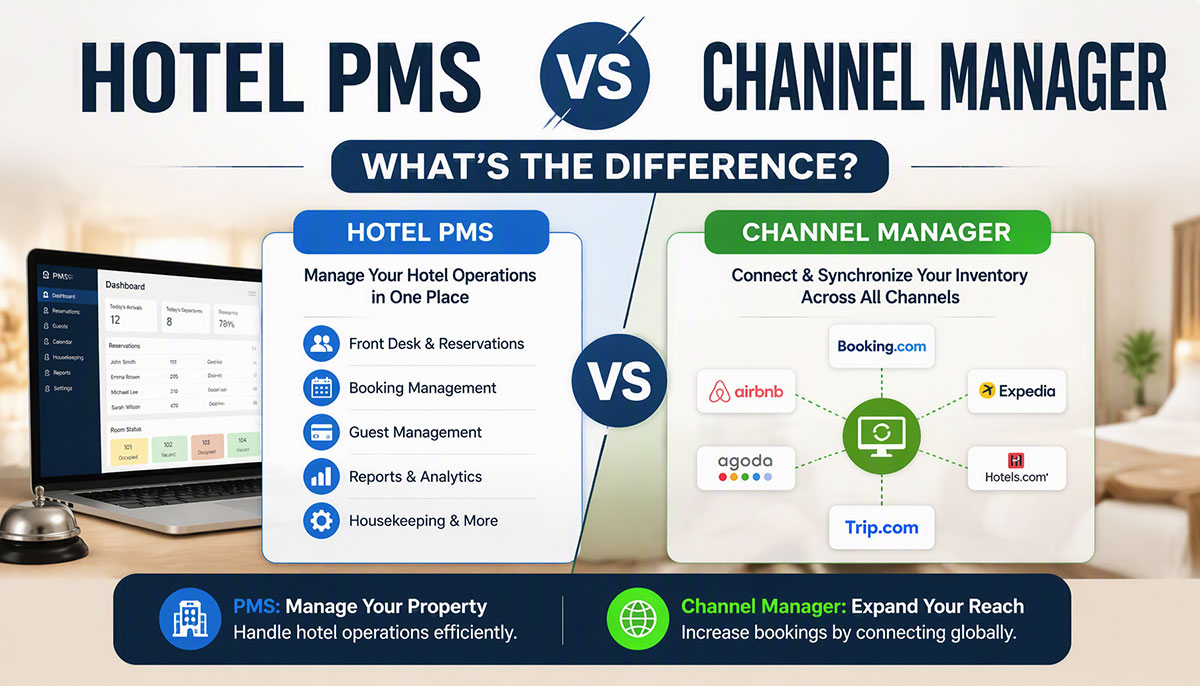
A hotel PMS (Property Management System) manages internal operations including reservations, front desk, housekeeping, billing, and guest profiles. A channel manager distributes room inventory and rates across OTAs (Booking.com, Expedia, Airbnb). PMS = internal operations; channel manager = external distribution. Most modern hotels need both, ideally integrated in one all-in-one platform.
If you're evaluating hotel technology for the first time, the difference between a PMS and channel manager can seem confusing. Both handle reservations, both sync data, and both claim to prevent overbookings. So which one do you need? The short answer: you likely need both, and understanding how they work together will save you from costly mistakes and operational headaches.
What Is a Hotel PMS (Property Management System)?
A hotel PMS is the core software that runs your property's daily operations. Think of it as the central nervous system of your hotel. It manages everything that happens inside your property: reservations, front desk check-ins and check-outs, room assignments, guest profiles, housekeeping schedules, billing and folios, night audit, and accounting.
The PMS is where your front desk staff creates reservations, assigns rooms, processes payments, and generates guest folios. It's where housekeeping sees which rooms need cleaning and marks rooms as clean or dirty. It's where your accounting team reconciles daily revenue and runs reports.
Every hotel needs a PMS, regardless of size or distribution strategy. Even a small 10-room guest house that only takes walk-in reservations needs software to track which rooms are occupied, who's in them, what they owe, and when they're checking out. Without a PMS, you're managing everything manually with spreadsheets, paper logs, and guesswork.
Modern cloud-based PMS platforms like EloPMS go beyond basic front desk operations. They integrate restaurant POS systems, banquet management, inventory control, and multi-property consolidation into one unified platform. This is the "all-in-one" approach that eliminates the need for disconnected point solutions. Read our complete guide to what is a hotel PMS for in-depth explanation.
What Is a Hotel Channel Manager?
A channel manager is distribution software that syncs your room inventory, rates, and availability across multiple OTAs (Online Travel Agencies) and booking channels in real-time. Its primary job is simple but critical: prevent overbookings and keep your rates consistent across all sales channels.
Here's the problem a channel manager solves: let's say you have 50 rooms and you list your property on Booking.com, Expedia, and Airbnb. A guest books on Booking.com. Without a channel manager, you'd need to manually log into Expedia and Airbnb to update your availability from 50 rooms to 49 rooms. Miss that update, and both platforms might sell the same room at the same time. That's an overbooking, and it means you're either denying a confirmed reservation (terrible guest experience) or scrambling to find alternative accommodation at your expense.
A channel manager automates this. The moment a booking comes in from any OTA, the channel manager instantly updates availability across every connected channel. One room sold on Expedia means Booking.com, Airbnb, Agoda, and every other connected OTA immediately shows one less room available. No manual updates, no overbooking risk.
The channel manager also distributes rate changes. Update your rate once in the channel manager, and it pushes to all OTAs simultaneously. This maintains rate parity (showing the same rate across all channels, which OTA contracts often require) and saves massive amounts of time compared to logging into 5-10 separate OTA extranets.
Channel managers connect to dozens or even hundreds of OTAs. The best ones connect to major global platforms (Booking.com, Expedia, Airbnb, Agoda, VRBO, Google Hotel Ads) plus regional channels. EloPMS's built-in channel manager connects to major global OTAs and regional channels, giving you maximum distribution reach without the complexity of managing separate integrations. Learn more in our guide to what is a hotel channel manager.
Key Differences: PMS vs Channel Manager (Comparison Table)
| Feature | Hotel PMS | Hotel Channel Manager |
|---|---|---|
| Primary purpose | Internal operations | External distribution |
| Core functions | Reservations, front desk, housekeeping, billing, guest profiles, accounting | OTA distribution, rate/inventory sync, prevent overbookings |
| Who uses it | Front desk, housekeeping, accounting, management | Revenue managers, reservations team, owners |
| Data managed | Guest info, folios, room status, staff tasks | Rates, availability, OTA listings |
| Integration | Integrates WITH channel manager (sends inventory/rates) | Integrates WITH PMS (receives bookings, sends inventory updates to OTAs) |
| Standalone use | ✅ Can operate without channel manager (manual OTA management) | ❌ Cannot operate without PMS (needs inventory source) |
| Do you need it? | ✅ Every hotel needs a PMS | ✅ Only if you list on OTAs (Booking.com, Expedia, Airbnb, etc.) |
| Typical cost | $200–$800/mo (20–100 room properties) | $50–$300/mo (standalone) OR included in all-in-one PMS |
| Top vendors | Cloudbeds, Mews, EloPMS, Hotelogix, eZee | SiteMinder, RateGain, AxisRooms (standalone); EloPMS, Cloudbeds (built-in) |
How PMS and Channel Manager Work Together
Understanding the integration workflow between PMS and channel manager is critical for smooth operations. Here's a step-by-step breakdown of how these systems communicate in real-time:
Step 1: PMS is the source of truth
Your hotel has 50 rooms. Your PMS knows current occupancy: 30 rooms booked, 20 rooms available. Your revenue manager sets the rate at $150 per night for Standard Rooms in the PMS.
Step 2: Channel manager distributes inventory and rates to OTAs
The channel manager (integrated with your PMS) pulls availability (20 rooms) and rate ($150) from the PMS. It then pushes this data to Booking.com, Expedia, Airbnb, Agoda, and every other connected OTA. Each OTA now displays: "20 rooms available at $150/night."
Step 3: Guest books on OTA (e.g., Booking.com)
A guest searches Booking.com and books 1 room for 2 nights at $150/night. Booking.com sends the reservation details to your channel manager via API.
Step 4: Channel manager updates PMS and all OTAs instantly
The channel manager receives the Booking.com reservation and immediately pushes it into your PMS. A new reservation is created automatically, room inventory is reduced by one. Simultaneously, the channel manager updates ALL connected OTAs: 19 rooms now available (not 20). This prevents Expedia, Airbnb, and other channels from selling the same room.
Step 5: Front desk checks in guest
When the guest arrives, your front desk sees the reservation in the PMS (it came from Booking.com, but it's treated exactly like any other reservation). They assign a room, create a folio, check in the guest. When the guest checks out two days later, the PMS updates the room status (vacant, dirty). Housekeeping cleans the room. The PMS marks it clean. The PMS tells the channel manager the room is available again. The channel manager updates all OTAs: 20 rooms available.
The key integration benefit: One reservation update syncs everywhere instantly. No manual calendar updates across multiple OTA extranets. No overbooking risk. No rate parity violations. This is why integrated PMS and channel manager systems are non-negotiable for any hotel listing on multiple OTAs.
Do You Need Both PMS and Channel Manager?
The answer depends on your distribution strategy.
Scenario 1: Small hotel (10–30 rooms), direct bookings only, no OTAs
- PMS: ✅ Required (front desk, housekeeping, billing)
- Channel manager: ❌ Not needed (no OTA distribution)
- Example: A boutique hotel relying entirely on direct bookings through their own website, walk-ins, phone reservations, and repeat guests.
This hotel needs a PMS to manage operations but has no OTAs to sync. A channel manager would provide zero value. However, if this hotel ever decides to list on Booking.com or Expedia to increase occupancy during low seasons, they'll need to add a channel manager immediately.
Scenario 2: Hotel on OTAs (Booking.com, Expedia, Airbnb)
- PMS: ✅ Required
- Channel manager: ✅ Required (prevents overbookings, syncs rates across OTAs)
- Example: Any hotel listing on 2+ OTAs needs a channel manager to avoid double bookings and manual rate updates.
This is the most common scenario. If you're on Booking.com and Expedia, managing availability manually means logging into two separate extranets every time you get a reservation, every time you close a room for maintenance, every time you change a rate. That's unsustainable. A channel manager automates all of it.
Scenario 3: Multi-property hotel group
- PMS: ✅ Required (multi-property PMS with centralized control)
- Channel manager: ✅ Required (sync inventory across all properties and all OTAs)
- Example: A hotel chain with 5+ properties needs centralized PMS and channel manager to manage distribution across the portfolio.
Multi-property operations add complexity. Each property has its own inventory, but ownership needs consolidated reporting, centralized rate management, and unified brand presence across OTAs. An all-in-one platform like EloPMS handles multi-property PMS and channel management natively, with head-office dashboards and property-level autonomy.
Bottom line: If you list on OTAs, you MUST have a channel manager (standalone or built into your PMS). If you rely on direct bookings only, a channel manager is optional. But every hotel needs a PMS.
Standalone vs Integrated (Built-In) Channel Manager
You have two options when adding a channel manager to your tech stack: buy a standalone channel manager that integrates with your PMS via API, or choose an all-in-one PMS that includes channel manager functionality built-in. The choice significantly impacts cost, complexity, and reliability.
Option 1: Standalone PMS + Standalone Channel Manager
- Example cost structure: Hotelogix PMS ($300/mo) + SiteMinder channel manager ($200/mo) = $500/mo total
- Pros:
- Best-of-breed approach (choose the best PMS and the best channel manager separately)
- Flexibility to swap vendors if one underperforms
- Potentially more OTA connections (standalone channel managers like SiteMinder specialize in distribution and may have deeper OTA partnerships)
- Cons:
- Higher total cost (two separate subscriptions)
- Integration complexity (PMS and channel manager must connect via third-party API; potential for sync failures, data mismatches, version incompatibility)
- Two vendor relationships (two support teams to coordinate when issues arise, two invoices, two contracts, two renewal cycles)
- Data sync delays (not always real-time; some integrations batch sync every 5-10 minutes, creating overbooking windows)
- Implementation time (third-party integrations require setup, testing, and debugging before go-live)
Option 2: All-in-One PMS with Built-In Channel Manager
- Example cost structure: All-in-one PMS platforms (e.g., EloPMS, Cloudbeds) include PMS + channel manager + booking engine in one subscription
- Pros:
- Lower total cost (one subscription instead of two; typical savings $200-300/mo)
- Seamless integration (native, real-time sync; zero API failures because it's the same codebase)
- One vendor relationship (one support team, one invoice, one contract)
- Faster implementation (no third-party integration setup; channel manager works out-of-the-box)
- Unified data model (guest data, reservations, rates, and OTA performance all in one system)
- Cons:
- Less flexibility (cannot swap out channel manager for an alternative if needed; however, most hotels never do this)
- Potential feature gaps (some all-in-one platforms may have fewer OTA connections than specialized standalone channel managers; verify OTA coverage before purchase)
Our recommendation: For small to mid-market hotels (20–150 rooms), all-in-one is optimal. Lower cost, simpler operations, and real-time sync reliability outweigh the theoretical flexibility of best-of-breed. For enterprise hotels (500+ rooms) with complex distribution needs and dedicated revenue management teams, standalone best-of-breed may justify the cost and complexity.
See EloPMS's PMS and channel manager in action — book a personalized demo or start a free trial.
Common Mistakes Hotels Make When Choosing PMS + Channel Manager
Mistake 1: Buying PMS without checking channel manager integration
You purchase a PMS that looks great on paper. Six months later, you decide to list on Booking.com and Expedia. You discover your PMS doesn't integrate with your preferred channel manager (or charges extra for the integration, or requires a custom API build). You're stuck with manual OTA management or forced to switch PMS vendors.
Fix: Verify PMS-channel manager integration BEFORE purchase. If buying separate systems, ask both vendors: "Does your PMS integrate natively with [channel manager X]?" and "Does your channel manager integrate natively with [PMS Y]?" Get confirmation in writing. If buying all-in-one, confirm OTA connectivity list matches your distribution strategy.
Mistake 2: Paying for PMS + channel manager + booking engine separately
The hotel pays $300/mo for PMS, $200/mo for channel manager, and $150/mo for booking engine. Total: $650/mo. They discover later that all-in-one platforms bundle all three at significantly lower total cost. They've been overspending for disconnected systems when one unified platform would deliver better integration and lower cost.
Fix: Evaluate total cost of ownership (TCO) before making purchase decisions. All-in-one platforms like EloPMS often deliver lower cost AND simpler operations. Calculate TCO across 12-36 months, not just month one.
Mistake 3: Using PMS without channel manager (while on OTAs)
The hotel lists on Booking.com, Expedia, and Airbnb but updates availability manually on each OTA extranet. Staff spend hours each week logging into multiple platforms. Overbookings happen monthly. Rate parity violations trigger OTA penalties. Staff burn out.
Fix: If you're on 2+ OTAs, a channel manager is non-negotiable. Automate distribution from day one.
Mistake 4: Choosing on-premise PMS + cloud channel manager
On-premise PMS requires you to be physically at the property to access it (or set up complex VPN). Cloud channel manager works from anywhere. This creates workflow friction. The revenue manager can't update rates remotely. The owner can't check reservations from home. Integration sync may fail when the on-premise server goes offline.
Fix: Choose cloud PMS + cloud channel manager (or all-in-one cloud platform) for remote access, automatic updates, and real-time sync reliability.
Mistake 5: Ignoring OTA connectivity
The hotel buys a channel manager that connects to Booking.com and Expedia but not Airbnb, Agoda, or Google Hotel Ads. They must manage Airbnb manually (defeating the purpose of a channel manager) or forego that channel entirely.
Fix: Verify OTA connectivity list before purchase. EloPMS connects to major global OTAs and regional channels. If you plan to expand to regional OTAs in the future (Middle East, Asia-Pacific), confirm those connections exist.
How EloPMS Combines PMS + Channel Manager (All-in-One)
EloPMS takes the all-in-one approach. Instead of buying a PMS and bolting on third-party channel manager, booking engine, and POS systems, you get everything in one unified cloud platform.
What's included in EloPMS:
- ✅ Full PMS: Front desk, reservations, housekeeping, billing, guest profiles, accounting, multi-property consolidation
- ✅ Built-in channel manager: Connects to major global OTAs and regional channels
- ✅ Commission-free booking engine: Direct bookings from your website with zero OTA commission (save 15–25% per booking)
- ✅ Real-time sync: Instant inventory and rate updates across PMS, OTAs, and booking engine
- ✅ Multi-outlet POS: Restaurants, bars, spa, banquet with charge-to-room integration
- ✅ Cloud-native: Access from anywhere, automatic updates, no on-premise servers
- ✅ Regional compliance: FBR e-invoicing (Pakistan) and ZATCA Phase-2 (Saudi Arabia) built-in
Pricing advantage:
A typical competitor stack costs: Hotelogix PMS ($300) + SiteMinder channel manager ($200) + standalone booking engine ($150) = $650/mo.
EloPMS all-in-one pricing is significantly lower while including MORE functionality (POS, accounting, compliance). Contact us for pricing tailored to your property size and needs.
Savings: $200-300/mo = $2,400-3,600/year, plus reduced implementation complexity, one vendor relationship, and real-time native sync reliability.
Why all-in-one wins:
- Lower cost: One subscription instead of three separate vendors
- Seamless integration: Native real-time sync (no third-party API failures)
- Simpler operations: One vendor, one support team, one invoice, one training process
- Faster implementation: No third-party integration setup; streamlined go-live process compared to multi-vendor integrations (typically 4-6 weeks)
PMS + Channel Manager Checklist: What to Look For
When evaluating a PMS:
- ✅ Does it integrate natively with your preferred channel manager (or include one built-in)?
- ✅ Cloud-based or on-premise? (Cloud = remote access, automatic updates, lower IT overhead)
- ✅ Multi-property support (if you have or plan multiple locations)?
- ✅ POS integration for F&B outlets with charge-to-room billing?
- ✅ Regional compliance (FBR for Pakistan, ZATCA for Saudi Arabia)?
- ✅ Transparent pricing (or hidden fees for add-on modules, per-room charges, transaction fees)?
When evaluating a channel manager:
- ✅ OTA connectivity: Does it connect to YOUR key OTAs (Booking.com, Expedia, Airbnb, Agoda, regional channels)?
- ✅ Real-time sync: Instant inventory and rate updates or delayed (5–10 min lag = overbooking risk)?
- ✅ Standalone cost or included in PMS?
- ✅ PMS integration: Does it integrate natively with your PMS (or require custom API setup)?
- ✅ Support for rate plans, restrictions, and promotions (or basic availability sync only)?
When evaluating all-in-one platforms:
- ✅ Total cost of ownership: PMS + channel manager + booking engine bundled vs. separate subscriptions?
- ✅ Feature completeness: Does "all-in-one" actually include channel manager and booking engine, or are they optional add-ons?
- ✅ OTA connectivity: Does the built-in channel manager connect to all your needed OTAs?
- ✅ Vendor reputation: Is the all-in-one vendor established (customer reviews, case studies, uptime SLA)?
Final Recommendation: Which Option Is Best for Your Hotel?
Best for small hotels (10–50 rooms, 1–2 OTAs):
All-in-one PMS with built-in channel manager (EloPMS, Cloudbeds). Lower cost, simpler operations, one vendor relationship.
Best for mid-market hotels (50–150 rooms, 5+ OTAs):
All-in-one PMS with built-in channel manager (EloPMS, Mews, Cloudbeds). Seamless integration, lower total cost, multi-outlet POS included for restaurants, bars, and spa.
Best for enterprise hotels (500+ rooms, complex distribution):
Best-of-breed PMS + standalone channel manager (Opera Cloud + SiteMinder, or all-in-one if feature-complete). Maximum flexibility, enterprise support, advanced revenue management features.
Best for regional hotels (Pakistan, Saudi Arabia, GCC):
EloPMS (only all-in-one with built-in FBR and ZATCA compliance). Regional compliance is a moat — competitors require third-party bolt-ons or lack compliance entirely.
Bottom line: Most hotels (80%) benefit from all-in-one PMS with built-in channel manager. Lower cost, simpler operations, faster implementation. Evaluate total cost of ownership (PMS + channel manager + booking engine) before choosing.
Ready to simplify your hotel operations with all-in-one PMS + channel manager? Schedule a free demo to see how EloPMS syncs OTAs, automates distribution, and eliminates third-party integration costs — or start your 14-day free trial today.
Sources
- OTA commission rates (15-30%): industry standard per EloPMS product documentation and brain/site-facts.md (verified 2026-08-15)
- Competitor pricing estimates: G2 reviews (Hotelogix, SiteMinder), vendor public pricing pages (accessed 2026-08)
- EloPMS product specifications: brain/site-facts.md (2026-08-15)
- OTA connectivity: EloPMS product documentation (major global OTAs + regional channels verified 2026-08-15)