Hotel Housekeeping Software: Complete Guide 2026
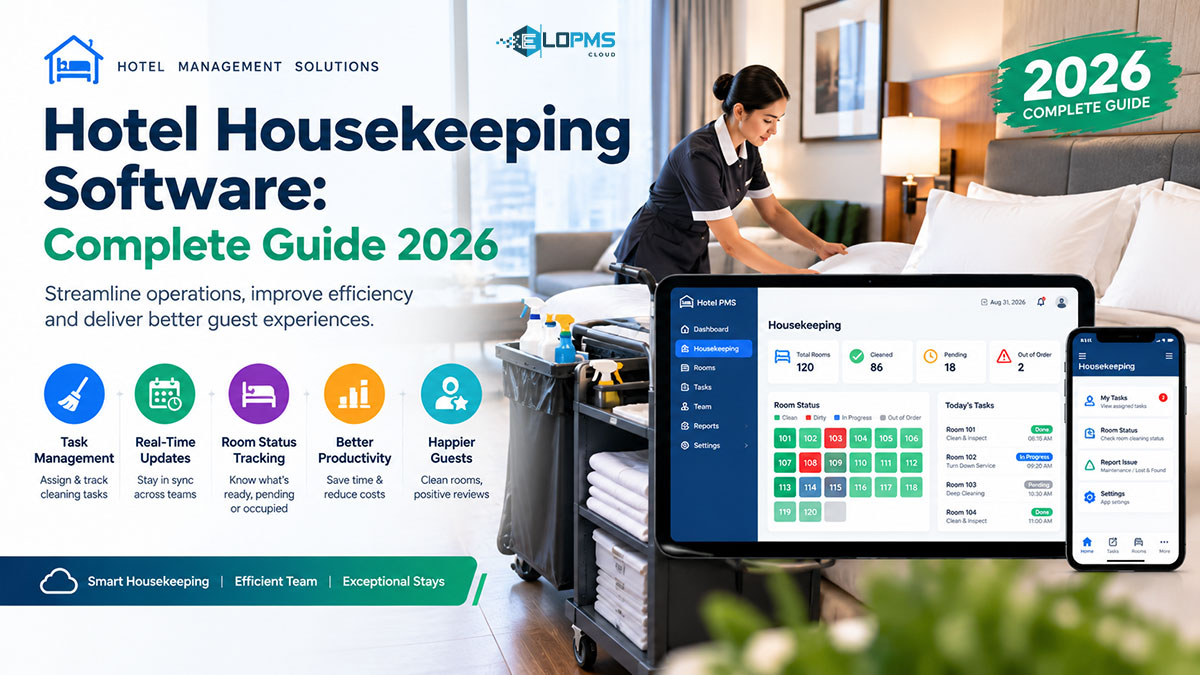
Managing hotel housekeeping with paper checklists and radio calls stops working at 15+ rooms. Manual processes lead to missed rooms, status sync delays between housekeeping and front desk, and no accountability trail when guests complain about cleanliness. This guide covers what hotel housekeeping software is, key features to look for, standalone tools versus all-in-one hotel property management system platforms, and how to choose the right system for your property.
What is Hotel Housekeeping Software?
Hotel housekeeping software is a digital platform that manages room status tracking, cleaning task assignment, staff scheduling, inspection checklists, and linen inventory. Modern systems integrate with hotel PMS to enable real-time room status updates between housekeeping staff and front desk, eliminating manual communication delays.
Housekeeping software digitalizes cleaning operations, task management, and quality control. Instead of supervisors running between floors with clipboards and calling the front desk on radio to update room availability, housekeepers use mobile apps to report status changes that appear instantly on the PMS tape chart.
Core functions include:
- Room status tracking showing dirty, clean, inspected, and ready status for every room
- Task assignment (automatic or manual) distributing rooms to housekeeping staff based on checkout schedules
- Mobile access allowing housekeepers to update status, upload photos of maintenance issues, and check task lists from smartphones
- Inspection checklists replacing paper SOPs with digital quality control workflows
- Reporting on rooms cleaned per shift, turnaround time, labor costs, and inspection pass rates
The evolution: From paper clipboards in the 1990s → desktop software in the 2000s → mobile-first apps in the 2010s → PMS-integrated unified systems today. Hotels with 15+ rooms typically adopt digital housekeeping to maintain service standards as manual coordination breaks down at scale. Target users include housekeeping supervisors, front desk managers, and general managers looking to reduce check-in delays caused by room status uncertainty.
Standalone Housekeeping Tools vs. All-in-One PMS Platforms
The first decision when evaluating housekeeping software: should you buy a standalone housekeeping tool that integrates with your existing PMS, or replace your entire system with an all-in-one PMS platform that includes housekeeping as a native module?
Comparison: Two Approaches to Housekeeping Software
| Feature | Standalone Tools (ALICE, Flexkeeping, HelloShift) | All-in-One PMS + Housekeeping (EloPMS) |
|---|---|---|
| Room status sync | API integration required; 5-15 min delays common | Real-time (housekeeper updates → front desk sees instantly) |
| Guest charges | Manual entry into PMS | Housekeeping charges auto-post to folio |
| Cost | $50-150/mo housekeeping + $100-200/mo PMS = $150-350/mo total | $100-200/mo bundled (all modules included) |
| Integration complexity | API setup, sync errors, vendor coordination | Zero integration (native modules) |
| Mobile access | Yes (housekeeping app) | Yes (unified mobile app for all staff) |
| Data silos | Housekeeping data separate from PMS | Unified guest ledger (one database) |
Standalone Housekeeping Tools
Standalone tools are designed for hotels that already have a PMS and want best-in-class housekeeping functionality. Examples include Flexkeeping, HelloShift, and Unifocus. These systems focus exclusively on housekeeping workflows with strong mobile UX.
Pros: Best-in-class housekeeping features, modular pricing (pay only for housekeeping), easier to swap vendors if needed, often have specialized features like preventive maintenance ticketing.
Cons: API integration required (which introduces 5-15 minute sync delays as data moves between systems), housekeeping charges (minibar restocking, damage fees) require manual entry into the PMS, double data entry (room status gets updated in the housekeeping tool AND the PMS), vendor coordination across two different support teams when issues arise.
All-in-One PMS Platforms
All-in-one platforms combine PMS, housekeeping, front desk, restaurant POS, and accounting in one unified database. Examples include EloPMS, Mews, and Cloudbeds. These systems treat housekeeping as a native module with real-time data sharing across all hotel operations.
Pros: Real-time room status sync with zero API delays (housekeeper updates status → front desk sees change on tape chart instantly), housekeeping charges automatically post to guest folio without manual entry, unified reporting combining occupancy and housekeeping efficiency metrics, lower total cost of ownership through bundled pricing, single vendor support contact for all issues.
Cons: The housekeeping module may be less feature-rich than dedicated standalone tools, though this gap is closing as PMS vendors invest in operations modules.
When to Choose Standalone
Large hotels (100+ rooms) with an established PMS they're satisfied with, properties with specific advanced housekeeping needs like multi-property housekeeping dashboards or deep preventive maintenance workflows, or hotels that prefer best-of-breed tools over integrated suites.
When to Choose All-in-One
Small-to-mid hotels (10-100 rooms) looking to reduce software complexity, properties replacing a legacy PMS while simultaneously adopting digital housekeeping, budget-conscious operators seeking to minimize total software costs, hotels that value real-time data flow between front desk and housekeeping over specialized features.
Key Features of Hotel Housekeeping Software
Whether you choose standalone or PMS-integrated, these eight features are essential for modern hotel housekeeping operations.
1. Real-Time Room Status Tracking
What it is: A digital dashboard showing dirty, clean, inspected, and ready status for every room in the hotel. Status changes propagate instantly from housekeeping staff mobile apps to the front desk PMS interface.
Why it matters: The front desk knows exactly which rooms can be sold for immediate check-in without calling housekeeping to ask "Is room 204 ready?" This eliminates check-in delays, especially critical during busy periods when early arrivals exceed the number of guaranteed clean rooms.
EloPMS implementation: Housekeepers update room status via the EloPMS mobile app. When a housekeeper marks room 204 as "clean," the front desk sees the status change on the tape chart within seconds—not minutes or hours. No manual sync, no phone calls, no uncertainty.
Metrics to track: Room turnaround time (minutes from checkout to clean to ready for sale), average cleaning time per room type (standard vs suite), and percentage of rooms ready by 3pm check-in time.
2. Digital Housekeeping Checklists
What it is: Mobile checklists replacing paper standard operating procedures. Housekeepers work through bedroom tasks (bed making, dusting, vacuuming), bathroom tasks (toilet, shower, mirror, amenities), and amenity checks (minibar, coffee, towels) with each item checked off digitally.
Why it matters: Quality consistency across all staff and shifts, training documentation for new hires who can follow the checklist step-by-step, compliance proof for health inspections requiring documented cleaning procedures.
Examples: Large hotel brands use digital checklists for franchise quality control. Flexkeeping offers simple customizable checklists that housekeepers complete on any smartphone.
EloPMS angle: Built-in customizable checklists per room type. A deluxe suite checklist includes different amenity standards than a standard room. Supervisors see completion percentage in real-time and can spot rooms where housekeepers are stuck or taking longer than expected.
3. Task Assignment & Scheduling
What it is: Systems that assign rooms to specific housekeepers based on checkout schedules, shift rosters, and workload balancing. Advanced systems offer automatic assignment algorithms that distribute work evenly.
Why it matters: Prevents overloading one cleaner with 20 rooms while another cleaner sits idle with 8 rooms. Auto-assignment saves supervisor time—no more manually writing room assignments on paper schedules each morning.
Automation example: HelloShift offers "auto-assign dirty rooms to next available housekeeper" functionality. As guests check out, the system automatically adds rooms to the queue and distributes them based on current workload.
EloPMS angle: Manual or automatic assignment modes. Integrates with the HR module so shift schedules inform task distribution—part-time staff working half-shifts get proportionally fewer room assignments.
4. Housekeeping Inspection & Quality Control
What it is: A two-step workflow where housekeepers clean and mark rooms "clean," then supervisors inspect and mark rooms "ready for sale" after verification. Supervisors can flag issues, attach photos, and reassign rooms for re-cleaning if needed.
Why it matters: Quality assurance before rooms are sold to guests. A housekeeper might miss a stain or forget to restock shampoo—the supervisor inspection catches these issues before they become guest complaints.
Metrics: Inspection pass rate (percentage of rooms passing first inspection without needing rework). Properties with strong training programs achieve high pass rates, while low pass rates typically indicate training gaps or rushed cleaning workflows.
EloPMS angle: Supervisors see all rooms marked "clean" awaiting inspection in a dedicated queue. They inspect, approve, or reject with notes explaining what needs fixing. Only supervisor-approved rooms show "ready" status to the front desk.
5. Mobile Access for Housekeeping Staff
What it is: Native iOS and Android apps that housekeepers use instead of paper lists and radio communication. Housekeepers view assigned rooms, update status with one tap, upload photos of maintenance issues (broken fixture, stained carpet), and receive notifications when urgent checkouts occur.
Why it matters: Real-time updates eliminate trips back to the housekeeping office to check paper lists or report completed rooms. Photo uploads enable better maintenance coordination—the maintenance team sees exactly what's broken before they arrive with tools.
Examples: Standalone apps like HotelCleanApp dominate app store searches for "housekeeping app." Properties using these apps report less supervisor time spent tracking down staff for status updates.
EloPMS angle: Native mobile app for all staff roles—housekeeping, front desk, restaurant servers. One app across the entire operation rather than separate apps per department. Housekeepers log in, see their assigned rooms, and start working. No separate login credentials or training for a different system.
6. Linen & Amenity Inventory Management
What it is: Tracking clean linen counts, dirty linen sent to laundry, par levels (minimum stock thresholds), and amenity stock like shampoo bottles, soap bars, coffee capsules. Systems trigger reorder alerts when stock falls below par.
Why it matters: Prevents stock-outs (running out of towels mid-shift), reduces theft and loss (digital counts vs physical counts reveal discrepancies), optimizes laundry schedules (send dirty linen when you have enough clean linen in reserve).
Integration: Links to the purchasing module. When shampoo stock hits the reorder point, a purchase requisition automatically generates for the procurement team.
EloPMS angle: Integrated with the inventory and purchasing module. Housekeeping consumption (shampoo, soap, toilet paper) automatically updates inventory levels. Monthly reports show cost per occupied room for amenities—useful for budgeting and identifying waste.
7. Housekeeping Reporting & Analytics
What it is: Reports showing rooms cleaned per housekeeper per shift, average room turnaround time, labor costs, inspection pass rates, and productivity trends over time. Exportable to Excel or viewable in dashboard format.
Why it matters: Labor optimization (identify slow performers or training needs), KPI tracking for management meetings, payroll reconciliation (verify claimed hours against rooms cleaned), trend analysis (are turnaround times getting worse?).
Industry benchmark: Mid-scale hotels typically handle 12-16 rooms per shift based on property type and service standards. Luxury hotels with suites and detailed turndown service may target 8-10 rooms. Properties below benchmark need to evaluate whether room complexity justifies lower productivity or if there are training/tool gaps.
EloPMS angle: 60+ built-in reports include housekeeping efficiency dashboards showing today's productivity, week-over-week comparisons, and individual housekeeper performance (anonymized for privacy). Export to Excel for deeper analysis or budget planning.
8. Housekeeping Charge-to-Room Integration
What it is: Extra cleaning charges (pet cleaning fee, deep stain removal), minibar restocking fees, damage charges (broken lamp, stained bedding) automatically post to the guest folio. Housekeepers or supervisors enter charges via mobile app, and they appear on the guest ledger in real-time.
Why it matters: Revenue capture—no missed charges because staff forgot to write them down and hand a paper slip to the front desk. Eliminates manual PMS entry and reduces errors (wrong room number, incorrect amount).
Standalone tool limitation: Most standalone housekeeping tools require API integration to post charges to the PMS, or worse, require front desk staff to manually type charges from the housekeeping app into the PMS. This creates a lag and potential for errors.
EloPMS differentiator: Housekeeping charges instantly appear on the guest folio because EloPMS uses a unified database. The housekeeper reports a PKR 500 minibar charge on room 305, and the front desk immediately sees it on the folio—no delay, no manual entry, no integration needed.
Benefits of Hotel Housekeeping Software
Digital housekeeping delivers measurable ROI across five key areas.
1. Faster Room Turnaround Time
Claim: Properties using housekeeping software report faster room turnaround times compared to paper-based workflows.
How: Real-time notifications ensure no delay in the workflow. Guest checks out at 11am → front desk marks checkout → housekeeper gets notification instantly → room cleaned by 12:30pm → supervisor inspects by 1pm → front desk sees "ready" status and can sell the room for early 3pm arrivals.
Impact: More same-day arrivals accommodated, reduced "your room isn't ready yet" complaints at 3pm check-in, higher RevPAR from selling rooms multiple times in one day (day-use bookings or early check-in upsells).
2. Reduced Labor Costs
Claim: Hotel operators report reduced labor costs through workload optimization and reduced idle time.
How: Auto-assignment prevents scenarios where one housekeeper finishes at 2pm with nothing to do while another is still cleaning at 5pm. Inspection workflows reduce re-cleans (catching quality issues early costs less than having a guest complain and needing emergency re-cleaning during occupancy). Digital task tracking reveals which staff consistently exceed productivity benchmarks and which need additional training.
Metrics: Track rooms cleaned per labor hour. If you're paying for 40 housekeeping hours and cleaning 80 rooms, you're at 2 rooms per labor hour. Software optimization might push that to 2.2-2.4 rooms per hour—same room count with fewer labor hours needed.
3. Improved Guest Satisfaction
Claim: Cleaner rooms and faster check-ins lead to higher guest review scores, particularly on cleanliness and service dimensions.
How: Digital checklists enforce SOPs across all staff (no shortcuts, no "I forgot to check the bathroom" scenarios). Faster turnaround eliminates "room not ready" delays that create the worst first impression. Quality inspection workflows catch issues before guests see them.
Source: Properties using digital housekeeping systems typically see fewer cleanliness complaints as consistency improves and accountability increases.
4. Better Accountability & Compliance
Claim: Digital audit trails protect properties during health inspections, guest disputes, and staff performance reviews.
How: Time-stamped task completion records show exactly when room 204 was cleaned and by whom. Photo evidence uploaded by housekeepers documents maintenance issues (broken fixture reported at 11:45am with photo). Inspection records prove supervisor quality checks occurred before the room was sold.
Compliance: FBR (Pakistan) and ZATCA (Saudi Arabia) require digital documentation for service charges. EloPMS includes built-in FBR and ZATCA compliance for housekeeping charges, ensuring e-invoices generate automatically when charges post to folios.
5. Elimination of Manual Communication
Claim: No more radio calls, phone tag between floors, or paper handoff between shifts.
How: All status updates happen digitally. Housekeepers don't need to walk to the office to report completed rooms—they tap "clean" on their phone. Supervisors don't call each housekeeper asking "Are you done with 304 yet?"—they see live status on their dashboard. Night shift doesn't inherit a paper list with crossed-out rooms and coffee stains—they get a clean digital handoff.
Staff benefit: Housekeepers spend more time cleaning and less time coordinating, with all updates happening digitally instead of requiring trips to the housekeeping office.
How to Choose Hotel Housekeeping Software
Evaluate tools across these six decision criteria.
1. Standalone Tool or All-in-One PMS?
Recap the comparison table from earlier. Decision guide: If you're replacing your PMS anyway (outdated system, lack of cloud access, poor vendor support), choose an all-in-one platform that includes housekeeping. If you have a modern PMS you're satisfied with and only need housekeeping functionality, a standalone tool makes sense.
Consider total cost of ownership: Standalone housekeeping tool at $100/month + PMS at $150/month = $250/month total. EloPMS all-in-one at $150/month bundled (includes PMS, housekeeping, restaurant POS, accounting, channel manager) = $100/month savings, or $1,200/year.
2. Mobile-First or Desktop-First?
Reality: Housekeepers need mobile access—they work on floors, not at desks. Supervisors and managers may use desktop dashboards for reporting and scheduling, but the core workflow must be mobile.
Red flag: Desktop-only systems or systems that require housekeepers to use clunky tablets with proprietary hardware. Modern systems use smartphones housekeepers already own (iOS + Android apps).
Check: Does the vendor offer native iOS and Android apps? Does the app work offline (for properties with weak Wi-Fi in some areas) and sync when connectivity returns?
3. PMS Integration Quality (if choosing standalone)
If you're buying a standalone housekeeping tool to integrate with your existing PMS, ask these questions:
- Is the integration real-time API or batch sync? Batch sync means status updates accumulate and transfer every 15 minutes—creating delays. Real-time API means updates happen within seconds.
- Who handles integration setup? Does the housekeeping vendor configure the API, or do you need to coordinate between two vendors? What happens if the integration breaks—who troubleshoots?
- What data syncs? Does it sync room status both directions (PMS → housekeeping for checkouts, housekeeping → PMS for clean status), or only one direction? Can housekeeping charges post to the PMS via API, or do they require manual entry?
EloPMS advantage: No integration needed. Housekeeping is a native module sharing the same database as front desk, POS, and accounting. Real-time sync is guaranteed because there's no API middleware—just different interfaces accessing the same data.
4. Customization & Scalability
Customization: Can you customize checklists per room type? A deluxe suite requires more amenities and different cleaning steps than a standard room. Can you customize task workflows (some properties require three-step workflows: cleaner → supervisor → manager approval)?
Scalability: Does pricing scale affordably as you add rooms or properties? Some vendors charge per room (5-10 USD/room/month), others charge flat fees (100-200 USD/month regardless of room count). For small hotels, flat fees win. For large hotels (50+ rooms), per-room pricing may be more economical if the base rate is low.
Multi-property support: If you operate 2+ properties or plan to expand, does the software offer consolidated reporting across properties? EloPMS multi-property management provides head office visibility into housekeeping performance across all locations from one dashboard.
5. Reporting & Analytics Depth
Must-have reports: Rooms cleaned per shift, turnaround time (checkout to ready), labor cost per room, inspection pass rate. These are operational essentials for managing housekeeping efficiently.
Nice-to-have: Predictive analytics (occupancy forecasts feeding housekeeping schedule optimization—if next Tuesday shows 80% checkout, schedule extra staff). Trend analysis (is average cleaning time increasing? Why?). Benchmarking (how does our turnaround time compare to industry standards?).
Check: Can you export data to Excel for custom analysis, or are you locked into the vendor's pre-built reports? Can you schedule automated report delivery (daily housekeeping summary emailed to the GM every morning at 8am)?
6. Pricing Transparency
Standalone tools: $50-150/month for small properties (10-30 rooms). Flexkeeping and similar modular tools offer transparent pricing published on their websites.
All-in-one PMS: Bundled pricing $100-200/month includes housekeeping plus PMS, POS, channel manager, and accounting. EloPMS uses contact-sales pricing (not publicly disclosed) but bundles all modules together.
Watch for hidden costs: Integration fees (some vendors charge $500-1000 for API setup), per-user fees (systems charging $10/user/month get expensive with 10+ housekeeping staff), contract lock-ins (one-year minimum commitments with early termination penalties).
Ask vendors for total cost of ownership examples: "For a 30-room hotel with 5 housekeeping staff, what is the monthly cost including all fees?"
Hotel Housekeeping Software Pricing Guide
Pricing tiers based on property size and feature depth:
Free/freemium: Limited features, ad-supported, or trial versions. Not suitable for hotels with 15+ rooms that need reliability and vendor support. May work for guest houses under 10 rooms with simple needs.
SMB standalone: $50-150/month for small-to-mid hotels (10-50 rooms). Flexkeeping and similar tools target this segment with affordable entry points and straightforward setup.
Enterprise standalone: $300-500/month for hotel groups and large properties (100+ rooms). Systems like Unifocus offer advanced features like preventive maintenance, multi-property dashboards, and integration with enterprise PMS platforms like Oracle OPERA.
All-in-one PMS bundled: $100-200/month transparent pricing for integrated platforms. EloPMS, Mews, and Cloudbeds bundle housekeeping with other modules. Some vendors use tiered pricing (more modules = higher monthly fee), others use flat bundled pricing (all modules included).
TCO Comparison Example
Standalone stack:
- Housekeeping tool: $100/month
- PMS: $150/month
- Total: $250/month = $3,000/year
EloPMS all-in-one:
- PMS + housekeeping + POS + channel manager + accounting bundled: $150/month
- Total: $150/month = $1,800/year
- Savings: $100/month = $1,200/year
This calculation doesn't include integration fees (standalone stacks often charge $500-1000 for API setup) or the time cost of coordinating between two vendors when issues arise. All-in-one platforms eliminate both.
Top Hotel Housekeeping Software Providers 2026
Brief vendor overview. These providers represent different approaches to housekeeping software—standalone tools, all-in-one platforms, and niche solutions. (See HotelTechReport for verified user reviews.)
1. EloPMS
Positioning: All-in-one cloud PMS with built-in housekeeping, POS, accounting, and compliance (FBR/ZATCA).
Best for: Independent and boutique hotels in Pakistan and GCC (10-100 rooms) replacing legacy systems or adopting digital operations for the first time.
Differentiator: Unified platform with zero integration complexity. Real-time room status sync, housekeeping charges auto-post to guest folio, commission-free booking engine, built-in FBR (Pakistan) and ZATCA (Saudi Arabia) compliance.
Pricing: Contact sales.
2. Flexkeeping
Positioning: Simple mobile-first housekeeping for small independent hotels and B&Bs.
Best for: Properties under 50 rooms wanting affordable entry into digital housekeeping without PMS replacement.
Differentiator: Easy setup (up and running in days), affordable pricing ($50-100/month), mobile-first UX designed for staff who aren't tech-savvy.
Pricing: Public pricing available on website (per property per month).
3. HelloShift
Positioning: Real-time housekeeping and guest request management for mid-scale hotels.
Best for: Properties that want to combine housekeeping task management with guest service requests (maintenance tickets, concierge requests) in one platform.
Differentiator: AI-powered auto-assignment to streamline scheduling and reduce coordination time.
Pricing: Contact sales.
4. Unifocus
Positioning: Enterprise housekeeping and workforce management for hotel chains.
Best for: Large hotel groups (100+ rooms per property, multiple properties) needing advanced scheduling, preventive maintenance, and labor analytics.
Differentiator: Deep integration with enterprise PMS platforms (Oracle OPERA, Infor), advanced workforce optimization algorithms.
Pricing: Enterprise pricing (contact sales).
5. Mews
Positioning: Modern cloud PMS with housekeeping module for tech-forward boutique hotels.
Best for: Design-conscious independent hotels and boutique chains that prioritize modern UX and automation.
Differentiator: Automation-first approach (auto-assignment, predictive scheduling), modern interface, strong mobile app.
Pricing: Tiered subscription based on room count.
6. Cloudbeds
Positioning: PMS with strong distribution focus (channel manager + booking engine) plus housekeeping module.
Best for: Small hotel chains and independent properties heavily reliant on OTA distribution.
Differentiator: Best-in-class OTA connectivity (200+ channels), bundled booking engine and channel manager alongside PMS and housekeeping.
Pricing: Tiered subscription based on room count and modules selected.
EloPMS Housekeeping Module: Unified PMS + Housekeeping
EloPMS solves the standalone integration pain by treating housekeeping as a native module in a unified platform.
Key features:
- Real-time room status sync: Housekeepers update status via mobile app → front desk sees changes on tape chart within seconds
- Digital checklists: Customizable per room type (standard, deluxe, suite)
- Two-step inspection workflow: Cleaner marks "clean" → supervisor inspects → supervisor marks "ready for sale"
- Housekeeping charges auto-post to folio: Minibar charges, cleaning fees, damage charges appear on guest ledger instantly—no manual PMS entry
- Integrated linen and amenity inventory: Links to purchasing module with automatic reorder alerts
- 60+ reports: Housekeeping efficiency dashboards showing rooms cleaned per shift, turnaround time, labor cost per room
- Mobile app access: Native iOS and Android app for all staff (housekeeping, front desk, restaurant)
- Multi-property dashboards: Head office visibility across all properties
- Built-in FBR (Pakistan) and ZATCA (Saudi Arabia) compliance: E-invoices generate automatically when housekeeping charges post to folios
Differentiator recap:
- All-in-one platform = zero integration complexity, no API delays, no vendor coordination
- Unified guest ledger = housekeeping charges instantly on folio without manual entry
- Transparent bundled pricing = lower total cost of ownership vs. standalone stacks
- Commission-free booking engine = keep more revenue instead of paying 15-30% OTA commissions
See EloPMS housekeeping in action. Book a free demo to see real-time room status tracking, digital checklists, and unified PMS integration. Or start your 14-day free trial—no credit card required.
Conclusion
Hotel housekeeping software digitalizes room status tracking, task management, and quality control—replacing paper checklists and radio calls with real-time mobile workflows.
Key decision: Standalone tool (best-in-class housekeeping UX, API integration required, separate from PMS) versus all-in-one PMS (real-time sync, lower total cost of ownership, zero integration complexity). Standalone makes sense for properties satisfied with their current PMS. All-in-one makes sense for properties replacing legacy systems or wanting to minimize software complexity.
Essential features: Real-time room status tracking, mobile access for housekeepers, digital inspection checklists, two-step inspection workflows (cleaner → supervisor), housekeeping reporting and analytics, linen and amenity inventory tracking, charge-to-room integration.
Pricing: $50-500/month depending on property size and feature depth. Small independent hotels: $50-150/month. Enterprise hotel groups: $300-500/month. All-in-one PMS platforms: $100-200/month bundled.
EloPMS differentiator: Unified PMS + housekeeping + POS + accounting in one cloud platform. Real-time room status sync (no API delays), housekeeping charges auto-post to guest folio (no manual entry), FBR (Pakistan) and ZATCA (Saudi Arabia) compliance built-in, transparent bundled pricing delivering lower total cost versus standalone stacks ($1,200/year savings in the TCO example above).
Ready to eliminate housekeeping integration headaches? See how EloPMS unifies your PMS, housekeeping, POS, and accounting in one cloud platform. Book a free demo or start your 14-day free trial today—no credit card required.
Sources
- HelloShift: https://www.helloshift.com
- Flexkeeping (pricing verified as of Sept 2026, redirects to main site): https://www.flexkeeping.com
- Mews: https://www.mews.com
- Cloudbeds: https://www.cloudbeds.com
- EloPMS Housekeeping Module: https://www.elopms.com/housekeeping-night-audit/
- EloPMS Front Desk: https://www.elopms.com/front-desk/
- EloPMS Inventory & Purchasing: https://www.elopms.com/inventory-purchasing/
- EloPMS Restaurant POS: https://www.elopms.com/restaurant-pos/
- EloPMS Multi-Property: https://www.elopms.com/multi-property/
- EloPMS Tax Compliance: https://www.elopms.com/tax-compliance/