
ADR (Average Daily Rate) in Hotels: Formula, Calculator & Guide
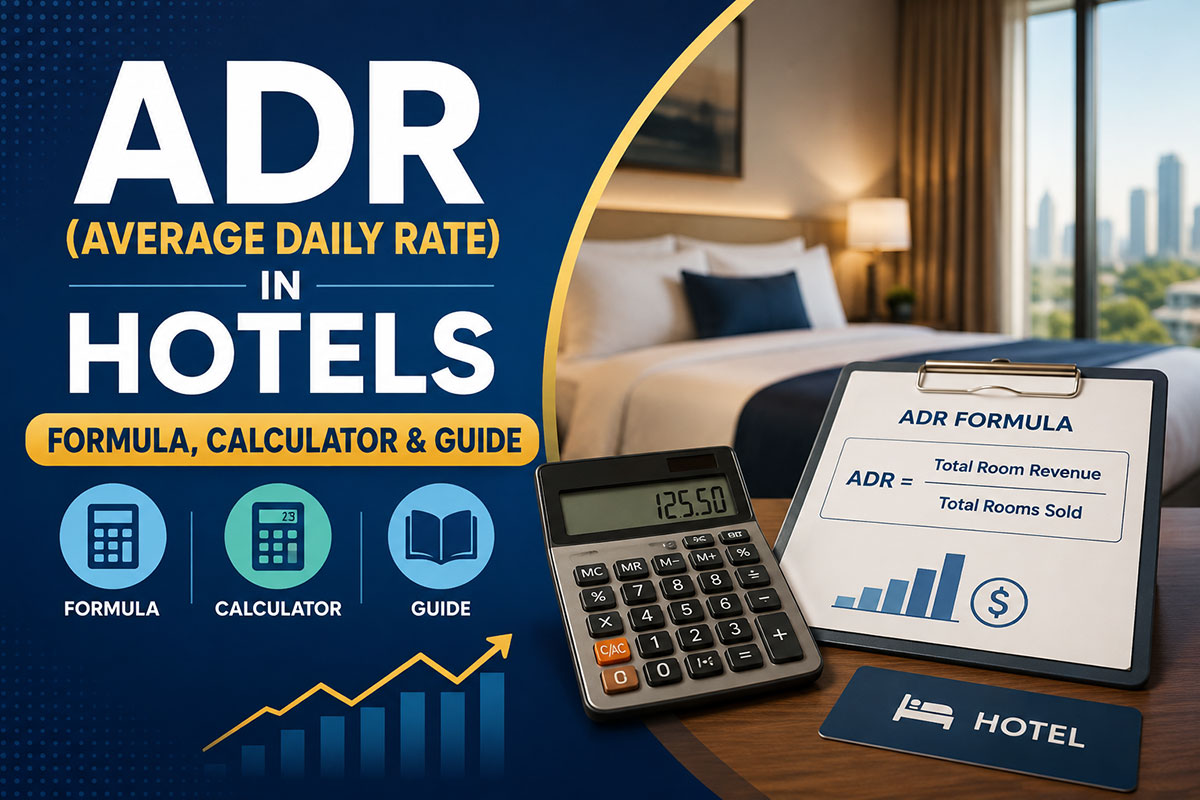
Average Daily Rate (ADR) is the average revenue earned per occupied room over a specific period. It is calculated by dividing total room revenue by the number of rooms sold, excluding taxes, service charges, and non-room revenue. ADR measures pricing effectiveness and helps hotels compare performance across periods and room types.
Hotels use ADR to evaluate pricing strategy, benchmark against competitors, and track revenue performance. This guide covers the ADR formula, worked examples, ADR vs ARR vs RevPAR comparison, and actionable tactics to improve ADR.
Modern hotel PMS software like EloPMS calculates ADR automatically in reporting dashboards, eliminating manual Excel tracking and providing real-time insights segmented by room type, rate plan, and booking channel.
What Is ADR (Average Daily Rate)?
ADR (Average Daily Rate) is the average revenue earned per occupied room during a specific period — day, week, month, or year. It represents the actual average price guests pay for rooms, not the theoretical rack rate.
What ADR includes: All room charges before taxes and fees — rack rates, discounted rates, corporate rates, package rates, OTA rates, and direct booking rates.
What ADR excludes: Taxes, service charges, VAT, and all non-room revenue such as food & beverage, spa services, minibar charges, banquet fees, parking, and laundry.
Why ADR matters:
- Pricing effectiveness — Are your rates aligned with market demand and guest willingness to pay?
- Performance tracking — Compare this week to last week, this month to last month, this year to last year to identify pricing trends
- Competitive benchmarking — Compare your ADR to competitors in your market segment (boutique, budget, luxury, resort)
- Revenue management — ADR is one of two levers for revenue performance (the other is occupancy); together they determine RevPAR
According to Cloudbeds, ADR is a key performance indicator in the hotel industry, providing useful information about hotel performance.
ADR Formula Explained
ADR = Total Room Revenue ÷ Total Rooms Sold
Breaking Down the Formula
Total Room Revenue: Sum of all room charges during the period (rack rates, discounted rates, corporate rates, packages) BEFORE taxes and service charges. Only base room rates and mandatory room-level fees (like resort fees or destination charges) count as room revenue. Revenue from room service, parking, spa, F&B, and minibar is excluded to keep ADR a pure measure of room pricing.
Total Rooms Sold: Number of rooms occupied during the period, also called "occupied room nights." Complimentary rooms, staff rooms, out-of-order rooms, and rooms used for operational purposes don't count as rooms sold — including these would artificially deflate ADR.
Example 1 (Daily ADR): A 50-room hotel in Lahore sells 35 rooms on Tuesday. Total room revenue = PKR 175,000. ADR = 175,000 ÷ 35 = PKR 5,000.
Example 2 (Weekly ADR): A 120-room resort in Riyadh sells 630 rooms in one week. Total room revenue = SAR 378,000. ADR = 378,000 ÷ 630 = SAR 600.
Example 3 (Monthly ADR): A 30-room guest house in Murree sells 720 rooms in January. Total room revenue = PKR 2,160,000. ADR = 2,160,000 ÷ 720 = PKR 3,000.
When to Calculate ADR
- Daily: Track day-of-week pricing patterns (are Fridays stronger than Mondays? Weekends higher than weekdays?)
- Weekly: Smooth daily volatility for better trend spotting
- Monthly: Standard reporting period for revenue managers and ownership
- Yearly: Long-term pricing trends and year-over-year growth tracking
- Segmented by room type: Compare ADR for Deluxe vs Suite vs Standard rooms
- Segmented by rate plan: Compare ADR for rack rate vs corporate rate vs OTA rate vs direct bookings
- Segmented by channel: Compare ADR from Booking.com vs Agoda vs direct bookings vs corporate contracts
Modern cloud hotel management systems like EloPMS calculate ADR automatically across all these dimensions — daily, weekly, monthly, by room type, by rate plan, by booking channel.
ADR vs ARR vs RevPAR — What's the Difference?
ADR, ARR, and RevPAR are three of the most commonly cited hotel metrics, and they're often confused. Here's the breakdown:
| Metric | Formula | What it measures | When to use it |
|---|---|---|---|
| ADR (Average Daily Rate) | Total Room Revenue ÷ Rooms Sold | Average revenue per occupied room | Pricing effectiveness, rate optimization, competitive benchmarking |
| ARR (Average Room Rate) | Total Room Revenue ÷ Total Rooms Sold (same as ADR) | Average revenue earned from occupied rooms over longer periods | Analyzing pricing trends over weeks, months, or seasons |
| RevPAR (Revenue Per Available Room) | Total Room Revenue ÷ Total Rooms Available OR ADR × Occupancy % | Revenue performance combining pricing AND occupancy | Comprehensive revenue performance metric (industry standard) |
ADR vs ARR — Key Difference
ADR and ARR use the same formula (Total Room Revenue ÷ Rooms Sold), but they're used in different contexts. ADR typically refers to daily rate calculation and emphasizes "per day per occupied room," while ARR is often used for longer periods (weekly, monthly, seasonal analysis).
Practical note: Many hospitality professionals use ADR and ARR interchangeably. The key distinction is context — ADR for daily/short-term pricing analysis, ARR for longer-period trend analysis. Both exclude vacant rooms from the calculation.
Read more: Average Room Rate (ARR): Formula, Calculator & Guide
ADR vs RevPAR — Key Difference
ADR measures pricing effectiveness only (how much revenue per occupied room), while RevPAR measures overall revenue performance (pricing × occupancy combined).
Example: Two hotels, same ADR, different RevPAR
- Hotel A: ADR = PKR 5,000, Occupancy = 60% → RevPAR = 5,000 × 0.60 = PKR 3,000
- Hotel B: ADR = PKR 5,000, Occupancy = 80% → RevPAR = 5,000 × 0.80 = PKR 4,000
Same ADR, but Hotel B has 33% higher RevPAR because of better occupancy.
When to focus on ADR: When occupancy is high and stable — optimize pricing to maximize revenue per room without sacrificing bookings.
When to focus on RevPAR: When you need a comprehensive view of revenue performance (pricing + occupancy together). RevPAR is the industry-standard metric for overall revenue health.
Understanding both ADR and RevPAR is essential for refining revenue strategies, as neither metric alone provides a complete picture of performance.
How to Calculate ADR — Step-by-Step
Step 1: Choose the time period (day, week, month, year)
Step 2: Collect total room revenue for that period
- Include: all room charges (rack rates, discounted rates, corporate rates, packages)
- Exclude: taxes, service charges, VAT, F&B, spa, minibar, parking, banquet, any non-room revenue
Step 3: Count total rooms sold during that period
- Rooms sold = occupied room nights (if a guest stays 3 nights in one room, that's 3 rooms sold)
- Exclude: complimentary rooms, staff rooms, out-of-order rooms
Step 4: Divide total room revenue by total rooms sold
Example calculation (weekly ADR for a boutique hotel):
20-room boutique hotel in Karachi, week of January 1–7, 2026:
- Monday: 12 rooms sold, PKR 72,000 revenue
- Tuesday: 10 rooms sold, PKR 60,000 revenue
- Wednesday: 11 rooms sold, PKR 66,000 revenue
- Thursday: 13 rooms sold, PKR 78,000 revenue
- Friday: 18 rooms sold, PKR 108,000 revenue
- Saturday: 19 rooms sold, PKR 114,000 revenue
- Sunday: 17 rooms sold, PKR 102,000 revenue
Total rooms sold: 100 Total room revenue: PKR 600,000 ADR: 600,000 ÷ 100 = PKR 6,000
Manual vs automated ADR calculation: Manually tracking ADR requires daily Excel updates and error-prone data entry. Modern cloud-based hotel property management systems like EloPMS calculate ADR automatically in real-time — daily, weekly, monthly, segmented by room type, rate plan, and booking channel.
Why ADR Matters for Hotel Revenue Management
1. Pricing Effectiveness
ADR tells you whether your pricing strategy is working. If ADR is declining month-over-month, you may be discounting too aggressively or losing pricing power to competitors. If ADR is increasing, you're capturing more revenue per guest (either through higher rates or better rate mix).
2. Competitive Benchmarking
Compare your ADR to competitors in your market segment (boutique, budget, luxury, resort). If your ADR is PKR 4,500 and competitors average PKR 6,000, you have a pricing gap — either justify it with differentiation or adjust rates. If your ADR is higher than competitors, ensure your value proposition supports the premium (better location, superior amenities, stronger service).
3. Rate Mix Optimization
ADR reveals the average outcome of your rate mix — rack rates, corporate rates, OTA rates, direct bookings, packages. If you're selling too many discounted OTA rates, ADR will be lower even with high occupancy. The goal is to optimize rate mix to maximize ADR without sacrificing occupancy (core revenue management principle).
4. Seasonal Trends
Track ADR across seasons to identify pricing opportunities:
- High season: ADR should increase (demand is high, guests are willing to pay more)
- Low season: ADR may decline (you may need to discount to maintain occupancy)
- Shoulder season: ADR stability indicates consistent pricing power
5. ADR × Occupancy = RevPAR
ADR is one of two levers for RevPAR (the other is occupancy). To increase RevPAR, you can either: (a) increase ADR (better pricing), (b) increase occupancy (more rooms sold), or (c) both. Revenue management is the art of balancing ADR and occupancy to maximize RevPAR.
How to Improve ADR — 7 Actionable Tactics
1. Upsell Higher-Value Room Types
When a guest books a Standard room, offer an upgrade to Deluxe or Suite at check-in or via pre-arrival email. Even a 20% upgrade conversion rate can increase ADR significantly. EloPMS front desk module supports upsell prompts at check-in to help staff maximize room revenue.
2. Dynamic Pricing Based on Demand
Adjust rates based on demand signals: occupancy forecast, day of week, local events, competitor pricing.
Tactics:
- High-demand periods (weekends, holidays, conferences): increase rates
- Low-demand periods (weekdays, off-season): maintain or slightly discount
- Use rate parity rules to ensure direct bookings remain competitive vs OTAs
3. Incentivize Direct Bookings
OTA commissions (15–30%) eat into net ADR — direct bookings have zero commission. Direct bookings improve net RevPAR by eliminating OTA commissions (which typically range from 15–30%).
Offer perks for direct bookings: free breakfast, room upgrade, late checkout, flexible cancellation. EloPMS commission-free booking engine integrates with your website for zero-commission reservations.
4. Segment Pricing by Room Type
Don't charge the same rate for all room types — price by value. Suites should have 30–50% higher ADR than Standard rooms. Sea-view, pool-view, or corner rooms should command 10–20% premium. Track ADR by room type to ensure you're capturing value appropriately.
5. Package Deals That Increase Perceived Value
Combine room + breakfast + spa + dinner into a package priced higher than room-only rate. Packages increase ADR while adding value for guests (they perceive savings even if total price is higher). According to Guestivo, when a guest hesitates on price, instead of dropping the rate, add value — a PKR 10,000 rate plus free breakfast worth PKR 1,500 feels like PKR 11,500 of value but costs only PKR 500–700 in marginal F&B cost.
Effective for weekend getaways, honeymoon packages, staycation deals.
6. Corporate and Group Rate Optimization
Corporate rates are often negotiated annually — review them quarterly to ensure they're not too low. If your market ADR has increased 10% but corporate rates are static, you're leaving money on the table. Group bookings: negotiate ADR minimums (e.g., minimum PKR 5,000 ADR for groups of 20+ rooms).
7. Minimize Low-Value OTA Dependency
OTAs with 15-30% commission reduce net ADR (gross ADR minus commission = net ADR). Shift traffic to lower-commission channels: direct bookings (0% commission), metasearch (cost-per-click), corporate contracts. Use OTAs for demand generation and fill, not as primary distribution.
Common ADR Mistakes to Avoid
Mistake 1: Confusing ADR with ARR
ADR and ARR use the same formula but different contexts. They're often used interchangeably, but understanding the context (daily pricing vs longer-period trends) matters for accurate analysis.
Mistake 2: Ignoring Occupancy When Evaluating ADR
High ADR with 40% occupancy is worse than moderate ADR with 80% occupancy. Always evaluate ADR and occupancy together — RevPAR is the combined metric that reveals true revenue performance.
Mistake 3: Comparing ADR Across Dissimilar Properties
A 10-room boutique hotel's ADR is not comparable to a 300-room resort's ADR (different markets, segments, amenities). Compare your ADR to similar properties (same city, same segment, same star rating).
Mistake 4: Not Tracking ADR by Channel
If Booking.com ADR is PKR 4,000 but direct booking ADR is PKR 5,500, you're over-reliant on discounted OTA inventory. Segment ADR by channel to understand where your best revenue comes from.
Mistake 5: Sacrificing ADR for Occupancy (or Vice Versa)
Chasing 100% occupancy by slashing rates destroys ADR and profitability. Pricing too high for elite ADR leaves rooms empty and tanks RevPAR. Balance is key — optimize for RevPAR, not ADR or occupancy alone.
How EloPMS Tracks ADR Automatically
EloPMS calculates ADR in real-time across every dimension that matters:
- Real-time ADR calculation: Daily, weekly, monthly automatically — no manual Excel work
- Segmented reporting: View ADR by room type (Standard, Deluxe, Suite), rate plan (rack, corporate, OTA, package), and booking channel (direct, Booking.com, Agoda, Expedia, corporate)
- Trend visualization: Compare this month's ADR to last month, this year to last year, identify seasonal patterns
- Revenue management insights: EloPMS reports show ADR, occupancy, and RevPAR together so you can optimize the balance
- Integration with accounting: ADR data flows into financial reports automatically — room revenue by source, channel contribution, net ADR after commission
Links: Front Desk, Reports & Analytics, Booking Engine, Channel Manager
Conclusion
ADR (Average Daily Rate) is one of the most important metrics in hotel revenue management — it measures average revenue per occupied room and reveals pricing effectiveness. Track ADR alongside occupancy and RevPAR to optimize your pricing strategy and maximize revenue.
EloPMS calculates ADR, occupancy, and RevPAR automatically in real-time dashboards — no manual Excel work, no data entry errors, no delayed insights. See how EloPMS helps hotels optimize revenue with automated reporting, segmented analytics, and channel-level ADR tracking.
Start your free trial or schedule a demo to see EloPMS reporting in action.