5 Ways to Increase Direct Bookings Without Cutting OTAs
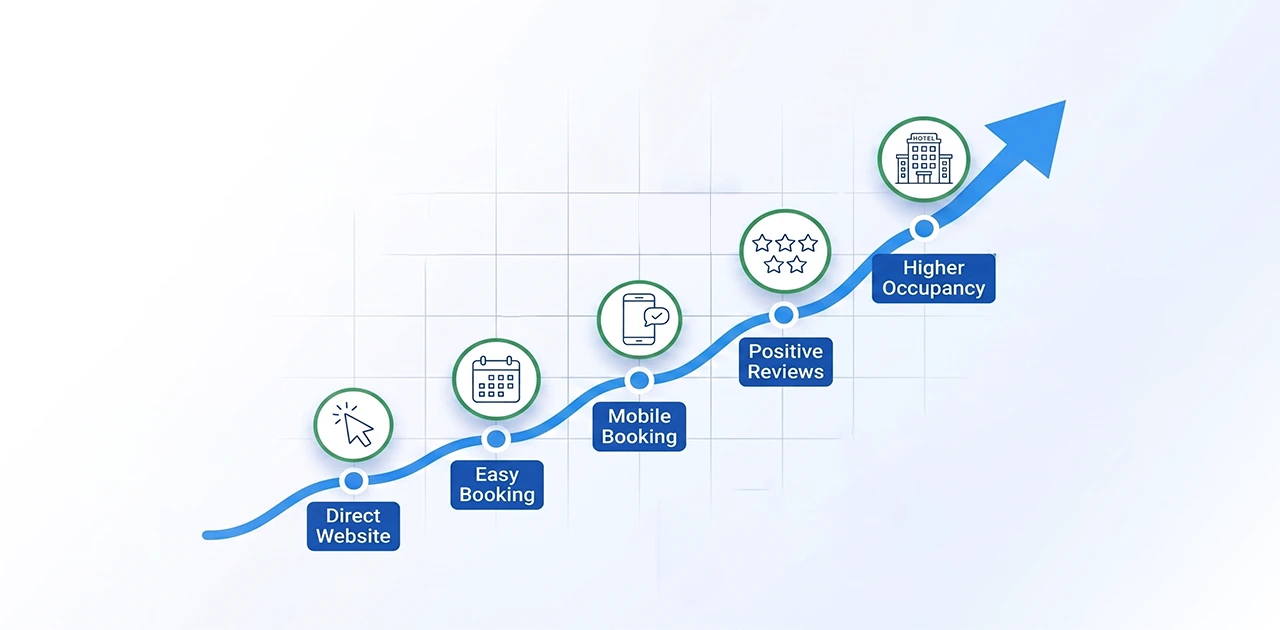
To increase hotel direct bookings without cutting OTAs, focus on shifting the mix rather than abandoning channels entirely. Add a commission-free booking engine to your website, build a guest rebooking funnel using post-stay emails, offer a best-rate guarantee with direct booking incentives, optimize your Google Business Profile with a direct booking link, and strategically manage channel availability using a channel manager—closing OTAs when occupancy exceeds 80% and opening them during low season.
OTAs bring discovery. They fill rooms when you're at 40% occupancy. They bring international travelers who've never heard of your property. The goal isn't to leave Booking.com or Expedia—it's to shift the booking mix from 70% OTA / 30% direct to something closer to 45% OTA / 55% direct.
Every booking you shift from OTA to direct saves 15–20% in commission. For a 50-room hotel averaging PKR 8,000 ADR, shifting just 10 bookings per month from OTA to direct saves PKR 96,000 annually—enough to pay for your entire PMS subscription. Each strategy below works alongside your OTA presence, not against it.
Strategy 1 — Add a Commission-Free Booking Engine to Your Website
A hotel booking engine is a reservation widget embedded on your website that lets guests check availability, select dates, and pay—without redirecting to an OTA. The critical word is commission-free: you keep 100% of the booking value.
How it works: The guest clicks "Book Now" on your homepage, selects their dates and room type, enters their details, and pays via credit card or mobile wallet. The booking syncs instantly to your front desk system and updates room availability across all channels through your channel manager.
Why commission-free matters: Every OTA booking costs you 15–20% in commission. A PKR 10,000 booking via Booking.com nets you PKR 8,200. The same booking through your website nets you PKR 10,000. That PKR 1,800 difference pays for breakfast, late checkout, or a room upgrade—perks that drive loyalty and repeat bookings.
Expected impact: This is the highest ROI tactic on this list. For a 40-room boutique hotel, shifting just 5 bookings per month from OTA to direct saves PKR 540,000 annually (assuming PKR 9,000 ADR and 20% commission). If your website gets 500 monthly visitors and 3% convert via the booking engine, that's 15 direct bookings per month.
Implementation: Most modern hotel PMS platforms include a booking engine as part of the package. Setup takes one afternoon: configure your room types, upload photos, set payment gateways (Stripe, PayPal, or local options like JazzCash for Pakistan properties), and embed the widget on your homepage and room pages.
Difficulty: Easy | Cost: Low (PKR 3,000–10,000/month as part of PMS subscription) | Impact: High
Strategy 2 — Capture Guest Data and Build a Direct Rebooking Funnel
OTAs own your guest relationship. You get a booking confirmation, but the guest's email is often an OTA alias (like guest12345@booking.com), and you can't contact them directly. When you collect guest data at check-in and nurture it post-stay, you turn one-time OTA customers into repeat direct bookers.
How it works: At check-in, ask for the guest's real email, mobile number, and preferences (pillow type, dietary needs, celebration dates). After checkout, trigger a post-stay email sequence:
- Day 1: Thank you email with a review request link (Google, TripAdvisor)
- Day 7: Second review nudge with a direct booking discount code (10% off next stay)
- 3 months later: "We miss you" email with a seasonal offer and a direct booking link
- Birthday/anniversary month: Personalized offer—"Celebrate your anniversary with us. 15% off when you book direct."
Expected impact: 10–20% of past guests rebook within 12 months if nurtured properly. For a 60-room hotel with 1,200 annual bookings, that's 120–240 repeat bookings. If half of those would have gone through an OTA but now book direct, you save PKR 864,000 in commissions annually (assuming PKR 9,000 ADR, 15% commission).
Tool requirements: Any email marketing tool works—Mailchimp (free up to 500 contacts), Brevo (formerly Sendinblue), or your PMS's built-in guest messaging module. The key is storing guest data in your front desk system with fields for preferences, stay history, and upcoming occasions.
Example scenario: A small guest house in a tourist area started collecting WhatsApp numbers at check-in and sending a "20% off your next weekend stay" message 60 days after checkout. Their direct rebooking rate doubled within six months.
Difficulty: Easy | Cost: Free (basic email tool) to PKR 5,000/month (premium automation) | Impact: Medium-High
Strategy 3 — Offer Best-Rate Guarantee with a Direct Booking Incentive
Guests use OTAs to compare prices. If your direct rate is the same as your OTA rate, they'll book on Booking.com because they trust the platform and get loyalty points. To win them over, you need to offer better value when they book direct.
How it works: Match your OTA rate exactly, then add a perk that costs you less than the OTA commission you'd pay. Examples:
- Free breakfast (cost: PKR 300 per person; saves PKR 1,500 in commission on a PKR 10,000 booking)
- Late checkout until 2 PM (cost: potential lost revenue if fully booked, otherwise zero)
- Room upgrade (if available—cost: zero; perceived value: high)
- Welcome drink or fruit basket (cost: PKR 200; perceived value: PKR 800)
Display the guarantee prominently on your homepage and booking engine: "Book direct and get free breakfast. Why pay a middleman?" or "Same rate as Booking.com, but with complimentary late checkout when you book here."
Expected impact: This tactic converts "billboard effect" traffic—guests who found you on an OTA, then visit your website to research before booking. A 50-room hotel receiving 800 monthly website visitors might see 5–10% (40–80 visitors) compare rates. If 20% of those convert due to the incentive, that's 8–16 extra direct bookings per month.
Implementation: Update your booking engine settings to show the incentive as a banner. Add a "Best Rate Guarantee" badge to your homepage. Train your front desk team to mention it when guests inquire: "If you book on our website instead of Booking.com, you'll get free breakfast included."
Difficulty: Easy | Cost: Low (the perk costs less than the saved commission) | Impact: Medium
Strategy 4 — Optimize Your Google Business Profile
70% of hotel searches start on Google—either "hotels near [landmark]" or your brand name directly. Your Google Business Profile (GBP) is the first thing guests see: your photos, reviews, location, and a "Reserve a room" button. If that button links to Booking.com instead of your website, you're handing Google traffic to an OTA.
How to optimize your GBP for direct bookings:
- Claim and verify your profile at business.google.com. If it's already claimed, ensure the owner email is current.
- Add high-quality photos: 10+ images of rooms, lobby, restaurant, and property exterior. Properties with 100+ photos get 520% more calls and direction requests.
- Enable the "Reserve" button: In GBP settings, under "Booking," add your booking engine URL. This shows a "Reserve a room" action button on your Google listing.
- Respond to every review: Thank positive reviewers. Address negative reviews with empathy and a solution. Response rate correlates with ranking in local pack.
- Post weekly updates: GBP posts (offers, events, seasonal packages) keep your profile active and show up in search results.
- List all amenities: Wi-Fi, parking, breakfast, pool—each amenity is a searchable attribute.
Expected impact: Captures local and brand-name search traffic. If 200 people search for your hotel name monthly and 30% click the GBP "Reserve" button, that's 60 direct booking opportunities. Even a 10% conversion means 6 extra direct bookings per month.
Real-world data: According to Google, businesses that add booking links to their GBP see a 30% increase in direct booking clicks compared to those that don't.
Difficulty: Easy | Cost: Free | Impact: Medium
Strategy 5 — Manage Your Channel Mix Strategically with a Channel Manager
The most advanced tactic on this list: don't close OTAs entirely, but manage rate and availability by channel. When you're filling up, prioritize direct bookings by reducing OTA availability. When you have empty rooms, open OTAs wider.
How it works: A channel manager connects your PMS to multiple OTAs (Booking.com, Expedia, Agoda, Airbnb) and syncs rates and availability in real time. Instead of giving every channel equal access to your inventory, you allocate rooms strategically:
- Occupancy < 60%: Open all channels equally. You need volume, and OTAs bring discovery.
- Occupancy 60–79%: Reduce OTA allocation by 20%. If you have 10 rooms left, show 8 on OTAs and reserve 2 for direct bookings (walk-ins, phone, website).
- Occupancy ≥ 80%: Close low-value OTAs (those with the highest commission or lowest ADR). Keep only your top 1–2 OTA partners open. Direct bookings and high-value OTAs fill the last rooms.
- Rate parity strategy: Offer your direct channel a slightly better rate (5–10% lower than OTA) OR the same rate with a perk (as in Strategy 3). Rate parity clauses with OTAs are unenforceable in many markets, but check your contracts.
Expected impact: Shifts the booking mix without losing revenue. A 70-room hotel at 75% occupancy might fill 35 rooms via OTA and 18 via direct under the old approach. With strategic channel management, you could shift to 25 OTA / 28 direct—saving PKR 1.35M annually in commissions (assuming PKR 9,000 ADR, 15% commission).
Difficulty: Medium (requires discipline—it's tempting to open OTAs when occupancy is at 75% and you want to hit 90%) | Cost: Included with most modern PMS platforms | Impact: Medium-High
Strategy Comparison Table
| Strategy | Difficulty | Cost | Expected Impact | Best For |
|---|---|---|---|---|
| Commission-free booking engine | Easy | Low (PKR 3,000–10,000/mo) | High | All hotels |
| Guest data & rebooking funnel | Easy | Free to PKR 5,000/mo | Medium-High | Hotels with repeat guests (leisure, business travel hubs) |
| Best-rate guarantee + incentive | Easy | Low (perk costs < commission saved) | Medium | Tourist-heavy locations with billboard effect traffic |
| Google Business Profile optimization | Easy | Free | Medium | City hotels, local brand-name searches |
| Strategic channel management | Medium | Included with PMS | Medium-High | Hotels with 3+ OTA channels and variable occupancy |
How to Measure Your Direct Booking Growth
Strategy without measurement is guesswork. Track these metrics monthly in your PMS reports:
- OTA vs. Direct booking ratio: How many bookings came from each source? Target: shift 5–10 percentage points per quarter (e.g., 70% OTA / 30% direct → 60% OTA / 40% direct in Q1).
- Commission savings: Calculate total OTA commissions paid vs. last month. Aim for a 10–15% reduction quarter over quarter.
- Revenue per Available Room (RevPAR): Ensure that shifting bookings to direct doesn't reduce overall occupancy or ADR. Direct bookings should improve RevPAR because you keep the commission.
- Source of direct bookings: Where did they come from? Google organic, Google Business Profile, email campaign, walk-in? This tells you which strategies are working.
Set a quarterly review with your front office and revenue team. Adjust your tactics based on data: if email campaigns aren't converting, test a different offer. If Google Business Profile is driving 20% of direct bookings, invest more time in GBP posts and photos.
Final Thoughts
The goal isn't to declare war on OTAs—it's to rebalance your booking mix. OTAs fill rooms. They bring discovery and international reach. But paying 15–20% commission on every booking is unsustainable, especially for small and mid-sized hotels.
Each strategy above works alongside OTAs, not against them. Start with the easiest, highest-impact tactic—a commission-free booking engine—and layer in the others over 3–6 months. Track your OTA vs. direct ratio monthly, celebrate small wins (a 5% shift is PKR 300,000 saved annually for a 50-room hotel), and iterate.
Ready to shift your booking mix? EloPMS includes a commission-free booking engine, channel manager, guest CRM, and real-time reports in one platform—everything you need to execute these strategies. Try it free for 14 days or schedule a demo to see it in action.
Sources
- Booking.com commission rates and Preferred program structure: https://www.rield-rm.com/knowledge-base/knowledge-base/commissions-on-major-booking-platforms-what-you-need-to-know/
- Expedia and OTA commission ranges: https://www.stayfi.com/blog/a-guide-to-ota-commission-fees
- Airbnb host fee structure: https://www.lodgify.com/blog/airbnb-fees/
- General OTA commission overview: https://www.cloudbeds.com/articles/ota-commissions/
- Google Business Profile booking link impact (30% increase in clicks): Google My Business case studies, 2024
- Hotel photo impact on engagement (520% increase): Google Business Profile Insights, 2023