
Hotel No-Show Policy Guide: Best Practices to Reduce Revenue Loss
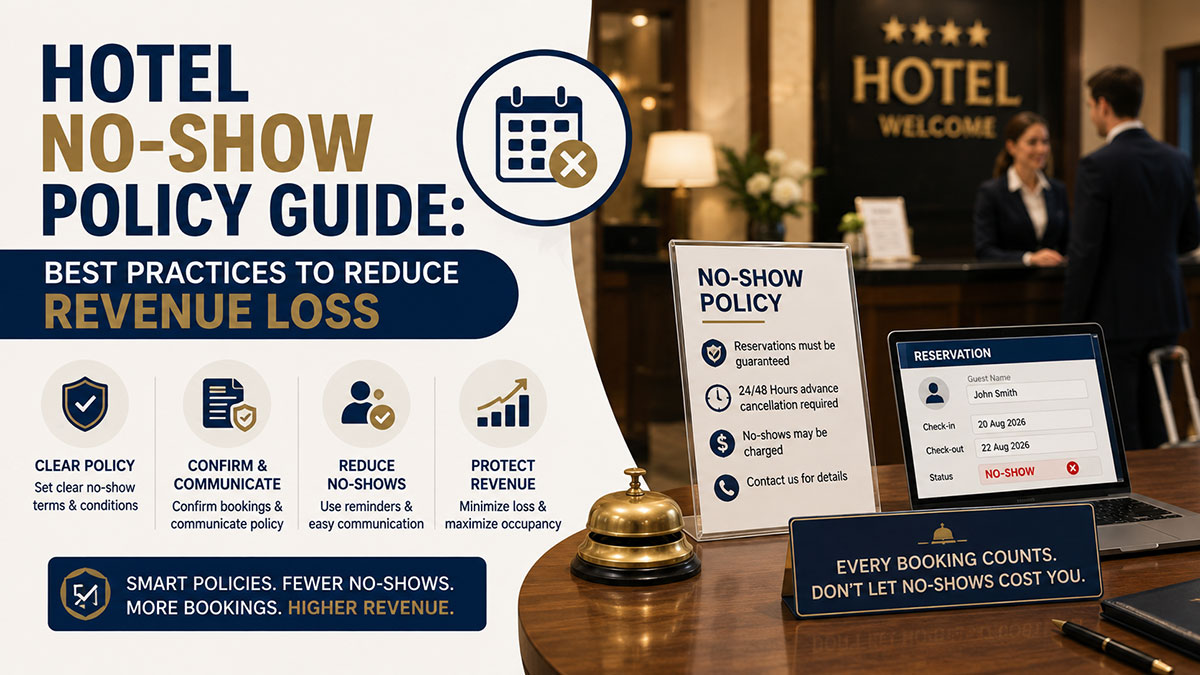
No-shows are one of the most frustrating challenges in hotel operations — a confirmed reservation walks away, leaving you with an empty room you could have sold. Industry data shows hotel no-show rates commonly range from 1-5%, representing thousands in unrecoverable revenue annually.[^1] This guide shows you how to create clear no-show policies, enforce fees without harming guest relationships, and use PMS automation to turn a revenue leak into a manageable process.
What Is a Hotel No-Show?
A hotel no-show occurs when a guest with a confirmed reservation fails to arrive and does not cancel. No-shows cost hotels significant revenue — typically 1-5% of all bookings.[^1] Hotels can charge no-show fees (usually one night's room rate) if the policy is clearly disclosed at booking. Reducing no-shows requires credit card guarantees, pre-arrival reminders, and PMS automation.
Unlike a cancellation — where a guest notifies the hotel they won't arrive — a no-show happens without any communication. The hotel holds the room, turns away other potential guests, and loses revenue when the guest simply doesn't appear.
Common Causes of No-Shows
- Travel disruptions: flight cancellations, weather, or family emergencies that prevent arrival
- Booking errors: guests accidentally book multiple hotels and forget to cancel the others
- OTA abandonment: guests find cheaper rates elsewhere after booking
- Simple forgetfulness: especially common with bookings made weeks or months in advance
The Cost of No-Shows (Why Hotels Must Act)
No-shows are pure revenue loss. Unlike cancellations with advance notice — where you can resell the room — a no-show leaves you with an empty room for that night.
Direct revenue loss: An empty room means 100% lost revenue for that night. You've blocked the room from your inventory, prepared it for arrival, and staffed your front desk for check-in, but collected nothing.
Opportunity cost: You could have sold that room to a walk-in guest or someone on your waitlist. During high-occupancy periods, a single no-show can mean losing PKR 8,000-15,000 or more.
Operational waste: Housekeeping prepared the room. Front desk staff processed the reservation, printed folios, and waited for arrival. All wasted.
Forecasting disruption: High no-show rates make occupancy forecasting unreliable, which affects staffing, purchasing, and revenue projections.
Real-World Impact
A 50-room hotel with an average ADR of PKR 8,000 and a 3% no-show rate loses approximately 1.5 room-nights per night. Over a month, that's 45 lost room-nights = PKR 360,000 in unrecoverable revenue. Scale that to 5% no-shows, and you're looking at PKR 600,000 monthly — PKR 7.2 million annually — walking out the door.
Hotel No-Show Policy Best Practices
A clear, well-communicated no-show policy protects your revenue without alienating guests. Here's how to build one that works.
1. Clear Communication at Booking
Your no-show policy must be visible before the guest completes their booking. Display it prominently on:
- Your booking engine confirmation screen
- Booking confirmation emails
- The reservation details page on your website
State the penalty clearly: "Guests who do not arrive without prior cancellation will be charged one night's room rate."
Legal requirement: In most jurisdictions, penalty fees must be disclosed before payment. Hiding terms in fine print or adding them after booking makes them unenforceable.
2. Credit Card Guarantee Requirements
Require a valid credit card at booking — not just for payment, but as a guarantee. This simple step reduces no-show rates significantly because guests know they'll be charged if they don't show up.
Authorization vs charge: Authorize (pre-auth) the card for the first night's stay or full booking value at the time of booking. This places a temporary hold on the funds, confirming the card is valid without actually charging it. You only charge the card if a no-show occurs.
3. Advance Payment for High-Risk Bookings
For certain situations, require advance payment rather than just authorization:
- Peak season bookings: Demand is high and rooms are scarce
- Last-minute reservations: Bookings made within 48-72 hours of arrival
- Guests with no-show history: If your PMS tracks this
Balance revenue protection with guest experience: Partial advance payment (50% or first night) is often sufficient. If you require full advance payment, clearly state whether it's refundable or non-refundable.
4. Grace Period & Late Arrival Communication
Set a check-in cutoff time: "Reservations held until 6 PM unless guest confirms late arrival."
Contact protocol:
- Email or call the guest 24 hours before arrival to confirm they're still coming
- Contact them again at check-in time if they haven't arrived
- Give them a reasonable grace period (1-2 hours) before marking as no-show
Some hotels use "will-call" status: The guest must confirm their arrival to hold the reservation past the cutoff time.
5. Consistent Policy Enforcement
Train your front-desk staff to apply the policy uniformly. Inconsistent enforcement creates two problems:
- Guest disputes: "You waived the fee for my colleague last month, why not me?"
- Staff confusion: Without clear guidelines, front-desk agents make different decisions
Exception protocol: Empower managers to waive fees for documented emergencies (medical emergencies, documented travel disruptions), but log the reason. This protects you legally and maintains goodwill.
How to Charge Hotel No-Show Fees (Step-by-Step)
When a guest no-shows, follow this process to charge the fee professionally and minimize disputes:
Verify the no-show: Confirm the guest didn't arrive by check-in cutoff, didn't cancel, and didn't respond to your contact attempts.
Check the reservation terms: Review the booking confirmation. Was the no-show policy clearly disclosed? Did the guest agree by completing the booking? The booking confirmation is your contract.
Process the charge: Debit the authorized credit card. For corporate direct-bill accounts, send an invoice with the no-show charge.
Document the transaction: Note the no-show in your PMS folio. Attach proof: the original booking confirmation showing the policy disclosure.
Notify the guest: Send an email receipt explaining the charge. Include a copy of the no-show policy from the original confirmation email.
Handle disputes professionally: If the guest contests the charge, review the case. If the policy wasn't clearly disclosed, consider waiving the fee as goodwill. If it was clearly disclosed and agreed to, provide documentation to your payment processor to defend against chargebacks.
PMS automation: Modern hotel PMS systems streamline this workflow. When you mark a reservation as "no-show" after check-in time, the system can process the charge to the authorized card, generate a folio, and email the guest a receipt — all in one workflow.
Are Hotel No-Show Fees Legal? (Compliance & Enforceability)
Short answer: Yes, if clearly disclosed and agreed to at booking.
Hotel no-show fees are legally enforceable under contract law principles. When a guest makes a reservation, they enter into a contract with the hotel. If the terms clearly state a no-show penalty and the guest agrees by completing the booking, the hotel can charge that fee.
Jurisdictional Considerations
Hotel no-show fees are generally enforceable under contract law principles when clearly disclosed at booking and agreed to by the guest. However, enforceability rules and consumer protection standards vary by jurisdiction.[^4]
Best practices for compliance:
- Clear disclosure: Display your policy prominently during the booking process, before the guest confirms. Post-booking disclosure weakens enforceability.
- Reasonable fee limits: Courts and consumer protection agencies typically view penalties as enforceable when they reflect actual damages. Charging one night's room rate is widely accepted; charging the full multi-night stay value may be challenged as punitive rather than compensatory.
- Guest agreement: Ensure guests explicitly agree to terms before completing the booking. Card authorization at booking creates documented proof of consent and significantly improves chargeback win rates (businesses using card authorization win 89% of chargeback disputes versus 31% for post-hoc charges).[^4]
- Multi-language disclosure: If you operate in non-English markets or host international guests, display your policy in both English and the local language (Arabic for GCC properties, Urdu for Pakistan) to avoid disputes.
- International guests: Some jurisdictions (particularly in the EU and US) have consumer protection laws that may limit penalty amounts or require specific disclosure formats. If you regularly host international guests, consult a hospitality attorney to ensure compliance with their home country standards.
Important: Consult a hospitality attorney to ensure your no-show policy complies with local consumer protection laws and card network rules in your operating region.
Card Network Rules (Visa/Mastercard)
No-show chargebacks are common. Cardholders may dispute the charge, claiming they canceled within the allowed timeframe or that the policy wasn't disclosed.[^2]
Your win rate is high if you provide:[^2]
- The original booking confirmation showing the no-show policy
- Proof the guest agreed to the terms (completion of booking = agreement)
- Documentation of your contact attempts (emails, call logs)
Best practice: Don't charge more than one night's room rate. Courts and card networks view excessive penalties (e.g., charging the full stay value) as punitive, not compensatory. One night's rate is considered reasonable actual damages.[^4]
7 Strategies to Reduce Hotel No-Shows
Prevention is better than enforcement. These strategies reduce no-show rates before you ever need to charge a fee.[^3]
Send automated reminders: Email or SMS 48 hours and 24 hours before check-in. A simple "We look forward to welcoming you tomorrow — reply if plans change" gives guests a chance to cancel properly instead of ghosting.
Require credit card guarantee for all reservations: Guests are significantly less likely to no-show when they know they'll be charged. Even if you don't charge on no-show, the authorization alone reduces no-show behavior.
Flag high-risk bookings: OTA bookings with short lead time, guests with no-show history, and free-cancellation bookings close to arrival date all carry higher no-show risk. Monitor these more closely with extra confirmation calls.
Offer flexible cancellation (with deadline): "Cancel free up to 48 hours before arrival" reduces no-show rates. Guests are more likely to cancel properly when they know they won't be penalized for changing plans with reasonable notice.
Use overbooking strategically: Book 5-10% more than capacity to offset expected no-shows. Caution: Have a walk protocol ready (partner hotels, compensation, upgrades) in case more guests show up than you have rooms.
Implement a waitlist system: When sold out, maintain a waitlist. If someone no-shows, you can immediately offer the room to a waitlist guest, recovering the revenue.
Track no-show patterns by source: If certain OTAs, corporate accounts, or booking sources have consistently high no-show rates, adjust your policy or pricing for those channels. For example, you might require advance payment for high-risk OTA bookings.
How a Hotel PMS Automates No-Show Management
Manual no-show tracking is time-consuming and error-prone. A modern hotel PMS automates the entire workflow.
Reservation Policies Module
Set no-show fee rules by rate plan, season, or booking source. For example:
- Charge 100% for non-refundable bookings
- Charge 50% for flexible-rate no-shows
- Charge 0% (but track) for loyalty member bookings
Each rate plan carries its own no-show policy, and the system applies the correct one automatically.
Credit Card Vault & Authorization
The PMS securely stores guest credit card details using PCI-compliant tokenization. At booking, it authorizes the card for the guarantee amount. On no-show, front desk staff mark the reservation accordingly, and the system processes the charge using the stored authorization.
No-Show Flagging & Processing
The system alerts the front desk when a guest hasn't checked in by the cutoff time. Staff mark the reservation as "no-show" with one click. The charge processes automatically, a folio generates, and an email receipt goes to the guest — all logged in the audit trail for dispute resolution.
Reporting & Analytics
Track no-show rate by:
- Booking source (direct vs OTA vs corporate)
- Season (peak vs off-peak)
- Room type
- Rate plan (non-refundable vs flexible)
This data reveals patterns. If OTA bookings have a 5% no-show rate but direct bookings have 1%, you know where to focus your prevention efforts.
EloPMS example: EloPMS allows you to configure no-show policies at the rate-plan level. The system tracks no-shows automatically during the night audit process, stores guest credit cards securely, and logs every no-show event in the audit trail. You can run no-show reports by date range, source, and property to identify patterns and adjust policies accordingly.
Hotel No-Show Policy Template (Copy-Paste Ready)
Use this template as a starting point. Customize the charge amount, cancellation deadline, and contact information for your property.
No-Show Policy
A "no-show" occurs when a guest with a confirmed reservation does not arrive and does not cancel the reservation by 6:00 PM on the day of arrival.
Charges: Guests who no-show will be charged one night's room rate to the credit card on file.
Late Arrival: If you expect to arrive after 6:00 PM, please contact us at [phone] or [email] to confirm your reservation will be held.
Cancellations: To avoid no-show charges, cancel your reservation at least 24 hours before your scheduled arrival date.
By completing this booking, you agree to this no-show policy.
Usage note: Display this policy on your booking engine, include it in confirmation emails, and train your front-desk team on consistent enforcement. Adjust the cutoff time, charge amount, and cancellation deadline to fit your property's needs.
Protect Your Revenue Without Losing Guests
Hotel no-shows cost your property real revenue. A clear no-show policy — communicated at booking, enforced consistently, and automated through your PMS — recovers that revenue without damaging guest relationships.
The key is balance: make the policy firm enough to protect your business, but fair enough that honest guests don't feel punished. Most guests understand that holding a room has a cost, especially when you communicate the policy transparently from the start.
Automate your hotel's no-show policies with EloPMS. Configure fees by rate plan, track no-shows during night audit, and maintain a complete audit trail for dispute resolution. Book a free demo or start your 14-day free trial — no credit card required.
Legal Disclaimer: This guide provides general best practices for hotel no-show policies and is not legal advice. Hotel no-show policy enforceability varies by jurisdiction. Consult a hospitality attorney to ensure your no-show policy complies with local consumer protection laws and card network rules in your operating region.
Sources
[^1]: Hospitality Net: How to prevent hotel no-show and last-minute cancellations [^2]: Chargebacks911: Mastercard Reason Code 4853 No-Show Hotel Charge [^3]: WebRezPro: Cancellations and No-Shows Prevention Strategies for Hotels [^4]: Attenda: Can You Legally Charge a No-Show Fee? What Every Service Business Should Know