Bed and Breakfast Software: Features, Pricing & Top Options for 2026
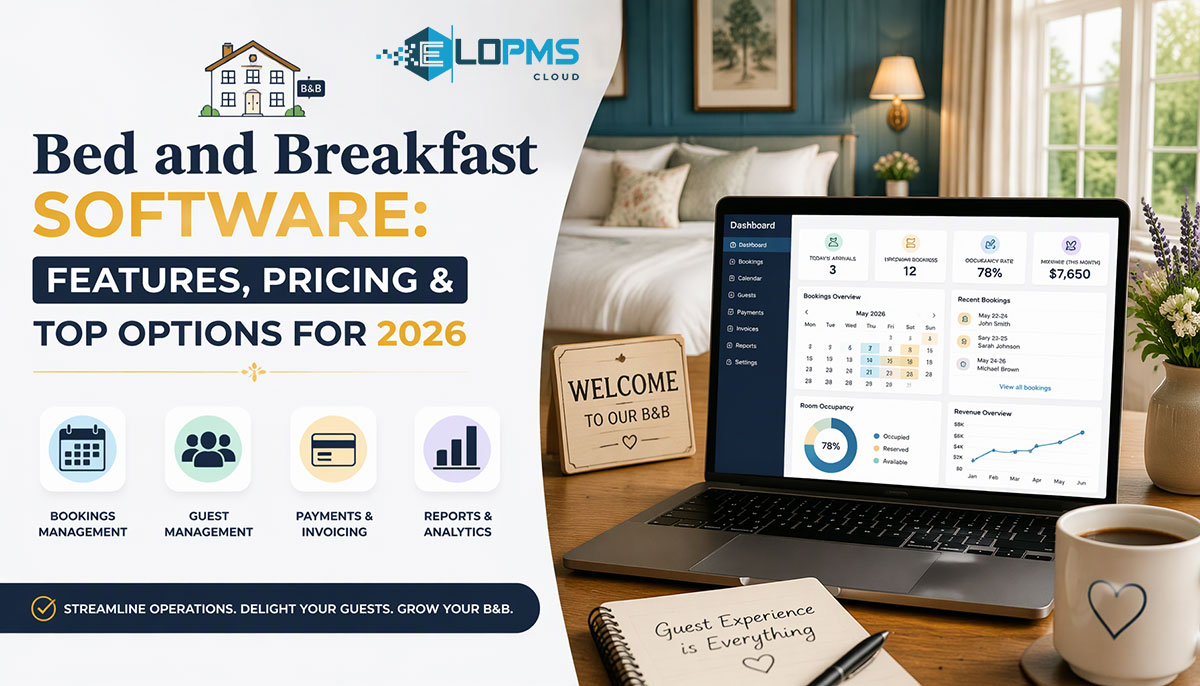
You're running a 6-room B&B, juggling reservation emails at 11 PM, handwriting breakfast orders at 7 AM, and manually tracking guest folios in Excel. There's a better way. Modern bed and breakfast software replaces this chaos with a single cloud platform that manages your bookings, breakfast service, and guest billing in one place. This guide covers what B&B software actually does, must-have features for small properties, and 5 platforms compared with pricing reality checks.
What Is Bed and Breakfast Software?
Bed and breakfast software is a property management system for small lodging properties that combines reservation management, check-in/checkout, breakfast service tracking, and billing in one cloud platform. It replaces manual logbooks and spreadsheets with automated bookings, meal charge tracking, and financial reporting. Designed for properties under 20 rooms with owner-operator models.
B&B software handles four core functions:
- Reservations: Online booking engine, availability calendar, guest database
- Guest management: Check-in/checkout workflows, folios, payment processing
- Operations: Housekeeping coordination, breakfast service tracking, night audit
- Reporting: Revenue reports, occupancy tracking, financial statements
The key difference from generic hotel PMS is scale and focus. B&B software emphasizes breakfast operations, simple interfaces for owner-operators, and pricing that makes sense for properties under 20 rooms.
Why B&Bs Need Different Software Than Hotels
Running a bed and breakfast isn't just managing a small hotel. The operational differences demand purpose-built software:
Property scale: Most B&Bs operate under 20 rooms with 2-5 staff members. Hotel PMS systems designed for 50-500 room properties include features like group bookings, convention management, and franchise integration that small B&Bs never use. This complexity increases training time and monthly costs without adding value.
Breakfast service: The defining feature of a B&B is breakfast. You need software that tracks guest meal preferences, manages dietary restrictions, coordinates kitchen orders, and charges extras to room folios. Standard booking software treats breakfast as a checkbox ("included: yes/no") without operational depth.
Owner-operated model: B&B owners wear ten hats: innkeeper, chef, housekeeper, marketer, accountant. Your software needs an intuitive interface you can master in one day, not enterprise systems requiring week-long training programs.
Budget reality: B&B owners operate on margins that require cost-effective software solutions. The right B&B platform should deliver booking automation, OTA integration, and basic reporting at a price point that fits small property economics.
7 Must-Have Features for B&B Software
1. Online Booking Engine (Commission-Free Direct Bookings)
A commission-free booking engine is your escape from 15-30% OTA fees. When guests book directly through your website, you keep 100% of the revenue instead of paying Booking.com, Airbnb, or Expedia their commission cut.
Look for these booking engine essentials:
- Real-time availability: Guests see live room availability without phone calls or email back-and-forth
- Instant confirmation: Automated emails sent immediately after booking, reducing guest anxiety and your workload
- Payment integration: Secure credit card processing with PCI compliance
- Mobile optimization: Most travel bookings now happen on mobile devices; your booking engine must work perfectly on small screens
EloPMS provides a 0% commission booking engine with instant confirmation emails, reducing guest anxiety and your workload without paying OTA commissions.
2. Channel Manager (OTA Sync)
A hotel channel manager connects your property to multiple OTA platforms from one dashboard. Instead of logging into Booking.com, Airbnb, Expedia, and Agoda separately to update rates and availability, you make one change that syncs everywhere.
Why this matters: Manual OTA management leads to overbookings. If you sell a room on Booking.com but forget to update your Airbnb calendar, you've double-booked that room and face cancellation fees, angry guests, and negative reviews.
Modern channel managers offer:
- Two-way sync: When a guest books on any OTA, your calendar updates instantly across all platforms
- Rate parity enforcement: Maintain consistent pricing across channels to avoid OTA penalties
- Bulk updates: Change rates for your entire month in one action, not 30 separate edits per platform
EloPMS includes channel manager functionality with OTA integration across major booking platforms including Booking.com, Airbnb, Expedia, and Agoda.
3. Guest Folio & Billing
Your guest folio is the itemized bill that tracks all charges during a stay: room rate, breakfast extras, late checkout fees, minibar purchases. B&B-specific folio requirements include:
Integrated meal charges: When a guest orders à la carte breakfast items beyond what's included, those charges automatically post to their room folio. No separate POS receipts to reconcile.
Split billing: Business travelers often need room and meals on separate folios for expense reporting. Your software should handle split payments without Excel gymnastics.
Tax calculation: Automated tax computation based on your location. For Pakistan B&Bs, this means FBR e-invoicing integration. For Saudi Arabia properties, ZATCA Phase-2 compliance. Most global platforms lack these regional tax features.
4. Breakfast & Meal Service Tracking
This is the B&B-specific differentiator that separates true bed and breakfast software from basic booking platforms.
A complete breakfast management system includes:
Guest dietary preferences: Track allergies (gluten, dairy, nuts), dietary choices (vegan, vegetarian, halal), and special requests (extra-crispy bacon, specific coffee roasts). This information flags at check-in so your kitchen knows before the guest comes down for breakfast.
Kitchen order management: What EloPMS calls KOT (Kitchen Order Ticket) or Kitchen Display System. Breakfast orders flow from front desk to kitchen digitally. No handwritten notes that get lost or misread.
Charge-to-room functionality: When guests order breakfast extras beyond included items, charges post directly to their folio. The POS and guest billing are one integrated system.
Recipe-based inventory: Track ingredient usage per meal served. Know when you're running low on eggs, bread, or coffee before you run out mid-service.
Here's why standalone booking software fails: It can note "breakfast included" but provides zero operational support for actually serving breakfast. You still manage orders manually, track dietary restrictions in a notebook, and hope you don't forget that the guest in Room 3 is allergic to shellfish.
EloPMS integrates restaurant and meal service POS directly into the property management system, giving B&Bs the breakfast operations tools that Cloudbeds and Little Hotelier lack.
5. Housekeeping Management
Small-property housekeeping management differs from hotel housekeeping in one critical way: your team is you, plus maybe 1-2 part-time helpers. You don't need complex shift scheduling or department hierarchies. You need simple task tracking.
Essential housekeeping features for B&Bs:
- Room status visibility: Quick view of which rooms are occupied, being cleaned, or ready for check-in
- Task assignment: Assign cleaning tasks when you have multiple helpers working different rooms
- Mobile updates: Staff marks rooms clean from a tablet or phone, updating front desk status in real-time
- Priority flagging: Early check-ins and VIP arrivals get cleaned first
The goal is eliminating walkie-talkie calls and trips to the supply closet to ask "Is Room 4 ready yet?"
6. Financial Reporting
B&B owners need three types of financial visibility:
Daily revenue reports: How much money came in today? What's the breakdown between room revenue, breakfast extras, and other charges?
Occupancy metrics: Industry-standard measurements include:
- ADR (Average Daily Rate): Total room revenue divided by rooms sold. Tells you the average price per occupied room.
- RevPAR (Revenue Per Available Room): Total room revenue divided by total available rooms (occupied or not). Measures overall property performance.
- Occupancy percentage: Rooms sold divided by total rooms available.
Tax compliance reporting: For Pakistan B&Bs, FBR e-invoicing generates tax-compliant digital invoices. For Saudi properties, ZATCA Phase-2 integration ensures compliance with Saudi tax authority requirements. For Malaysia, MyInvois support.
Link to financial reporting and accounting for deeper coverage of double-entry bookkeeping and chart of accounts integration.
7. Multi-Device Access
As a B&B owner, you'll check bookings from your phone at 10 PM when you hear an email ping. You'll update room availability from your laptop at breakfast. Your housekeeper will mark rooms clean from a tablet.
Cloud-based B&B software means:
- No local servers: No Windows server in your office that crashes and takes your property offline
- Automatic updates: Security patches and new features deploy automatically; you never manually install software updates
- Work from anywhere: Check bookings from home, your phone, or while traveling
- Data backup: Your guest data and financial records live in professionally managed data centers, not on one computer that could fail
Desktop-installed B&B software (like older versions of Gracesoft) requires you to be physically at your property to access the system. Cloud platforms eliminate this constraint.
Pricing Reality: What B&B Software Actually Costs
B&B software pricing follows three common models:
1. Per-room pricing: $5-15 per room per month
- Best for: Properties planning to expand room count
- Watch out for: Costs scale as you add rooms; a 15-room B&B at $10/room pays $150/mo, but the same B&B at 25 rooms pays $250/mo
- Typical platforms: Little Hotelier, RoomRaccoon
2. Flat-rate monthly fee: $50-300/month regardless of property size
- Best for: Established properties with stable room count
- Watch out for: Hidden add-ons (extra users, additional OTA connections, support packages)
- Typical platforms: EloPMS, Gracesoft
3. Per-booking fee: $2-5 per reservation
- Best for: Seasonal B&Bs with high occupancy variance
- Watch out for: Costs spike during peak season when you're busiest
- Less common: Most platforms avoid this model
Hidden Costs to Calculate
Software subscription fees are only part of your total cost:
Payment gateway fees: Credit card processing runs 2-3% per transaction. If you process $5,000 in direct bookings monthly, that's $100-150 in processing fees.
OTA connection fees: Some platforms charge per-channel activation fees. Budget for potential setup costs when connecting multiple OTA channels.
Setup and training: Some platforms charge for onboarding and staff training. B&B-focused platforms typically include basic setup free.
Add-on modules: Channel managers, revenue management, or advanced reporting sometimes cost extra. Verify what's included in base pricing.
Budget by Property Size
Realistic monthly software budgets based on property scale:
4-6 rooms: $50-100/month
- Focus on simple reservation management and basic booking engine
- Advanced features like revenue management provide minimal ROI at this scale
- Free trials let you test before committing
8-12 rooms: $100-200/month
- Budget supports robust channel manager for multi-OTA presence
- Breakfast tracking becomes valuable as complexity increases
- Staff task management (housekeeping coordination) pays for itself
15-20 rooms: $200-400/month
- Full-featured PMS with integrated POS justifies higher cost
- Multi-property features if you own multiple B&Bs
- Advanced reporting and forecasting tools
EloPMS offers a 15-day free trial with no credit card required, allowing B&B owners to test the full platform including breakfast POS integration before making budget commitments.
Top 5 Bed and Breakfast Software Platforms Compared
Here's how five major B&B platforms compare across key features:
| Platform | Best For | Booking Engine | Meal Tracking | Pricing Model | Free Trial |
|---|---|---|---|---|---|
| EloPMS | All-in-one with F&B | ✅ Included | ✅ Integrated POS | Flat monthly | 15 days |
| Cloudbeds | Multi-property groups | ✅ Included | ⚠️ Limited | Per-property | 14 days |
| Little Hotelier | Simple reservations | ✅ Included | ❌ None | Flat monthly | 30 days |
| RoomRaccoon | Commission-free focus | ✅ Included | ⚠️ Basic | Per-room | 14 days |
| Gracesoft | Budget-conscious | ✅ Included | ❌ None | Tiered | 14 days |
EloPMS — Best All-in-One for B&Bs with Restaurants/Breakfast Service
Unique strength: Among the platforms in this comparison, EloPMS integrates breakfast and meal service POS directly into the property management system. When a guest orders à la carte breakfast items, those charges automatically post to their room folio without separate reconciliation.
All-in-one architecture: The platform combines booking engine, channel manager, restaurant POS with kitchen display, and double-entry accounting in one system. No third-party integrations to manage or monthly add-on fees for basic functionality.
Geographic advantage: Built-in tax compliance for Pakistan (FBR e-invoicing), Saudi Arabia (ZATCA Phase-2), and Malaysia (MyInvois). If your B&B operates in these markets, EloPMS handles tax reporting that global platforms ignore.
Free trial: 15 days with full feature access, no credit card required. Test the breakfast POS integration and channel manager with your real bookings before committing.
Pricing: Contact sales for pricing specific to your property size.
Best fit: B&Bs that serve breakfast or run a small restaurant, Pakistan/GCC properties needing local tax compliance, owners who want one integrated platform instead of connecting multiple tools.
Schedule a demo to see the breakfast POS integration in action.
Cloudbeds — Enterprise Features, Higher Price Point
Strength: Cloudbeds offers robust channel manager connections and a mature marketplace of third-party integrations. If you need connections to specialized OTAs or want add-ons like email marketing automation, Cloudbeds provides extensive options.
Trade-off: Built for larger properties, Cloudbeds brings enterprise complexity to small B&Bs. The learning curve is steeper than owner-operated platforms, and the pricing model reflects its enterprise positioning.
Breakfast tracking: While Cloudbeds includes basic POS functionality, it lacks the breakfast-specific features (dietary restriction tracking, integrated kitchen display) that define true B&B operations software.
Pricing model: Per-property subscription with tiered feature access.
Best fit: B&B owners managing 2+ properties who need multi-property consolidation, or properties planning to scale from 10 rooms to 25+ rooms where enterprise features become valuable.
Little Hotelier — Simple, Reservation-Focused
Strength: Little Hotelier prioritizes ease of use over feature depth. The interface is intuitive for non-technical owners, and setup takes hours instead of days.
Trade-off: Limited breakfast and meal service functionality. Little Hotelier can note dietary restrictions in guest profiles, but lacks integrated kitchen order management or charge-to-room POS capabilities.
SiteMinder connection: Little Hotelier is owned by SiteMinder, providing strong OTA network access and distribution reach. However, this relationship focuses on distribution (getting bookings) rather than operations (managing breakfast service).
Pricing model: Flat monthly rate with tiered feature access.
Best fit: B&Bs offering simple continental breakfast (coffee, juice, pastries) where meal tracking isn't operationally critical, or properties that already use separate POS systems and only need reservation management.
RoomRaccoon — Commission-Free Messaging, EU/US Focus
Strength: RoomRaccoon emphasizes commission-free direct bookings with marketing positioning similar to EloPMS. They target the same pain point: reducing OTA dependency.
Geographic limitation: Strong presence in Europe and North America, but limited Asia and GCC support. Lacks regional tax compliance (FBR, ZATCA) that Pakistan and Saudi B&Bs require.
Breakfast features: Basic meal preference tracking but no integrated POS. Charges-to-room require third-party integration.
Pricing model: Per-room monthly fees.
Best fit: European and North American B&Bs focused on direct booking growth, properties already using standalone POS systems that just need reservation software.
Gracesoft — Established Player, Desktop Heritage
Strength: Gracesoft has served the B&B market for over a decade. The platform is feature-complete with solid guest management and reservation capabilities.
Trade-off: Originally desktop software, Gracesoft's cloud transition lags competitors. The user interface shows its age, and mobile access is less refined than cloud-native platforms.
Breakfast operations: Reservation-focused system with minimal meal service functionality. You can note breakfast preferences but lack kitchen integration.
Pricing model: Tiered pricing based on room count.
Best fit: Budget-conscious B&B owners who prioritize low monthly costs over modern interfaces and breakfast operations tools, or properties already invested in Gracesoft's desktop version making the transition to cloud.
How to Choose B&B Software: 5 Decision Criteria
1. Does It Handle Your Breakfast Service?
This is the single most important question for bed and breakfast software.
If breakfast is included in your room rate: You need meal tracking, dietary restriction alerts, and kitchen coordination. Can your software flag that the guest in Room 3 is vegan before they come down for breakfast? Can it track how many guests ordered the full English breakfast vs. continental?
If you offer à la carte breakfast: You need integrated POS with charge-to-room functionality. When a guest orders eggs Benedict, that charge must post automatically to their folio. Separate POS systems that require end-of-day reconciliation create billing errors and guest disputes.
If breakfast is simple continental: A basic reservation system may suffice. But evaluate whether your breakfast service might expand. Upgrading from reservation software to full PMS later means data migration headaches.
Here's the reality: Standalone booking systems cannot handle operational breakfast management. You'll end up running separate systems for reservations and meal service, then manually reconciling data at night audit. All-in-one platforms like EloPMS eliminate this friction.
2. Will It Actually Save You Time?
Every software vendor promises "time savings" and "automation." Test this claim concretely.
Time-saved calculation: List your current manual tasks and estimate hours per week:
- Answering "do you have availability?" emails: 3-5 hours
- Updating OTA calendars across platforms: 2-4 hours
- Processing breakfast orders and billing: 4-6 hours
- Generating daily/weekly reports: 1-2 hours
- Night audit reconciliation: 3-5 hours
If software eliminates 10-15 hours of weekly tasks, that's 40-60 hours monthly. At an opportunity cost of $20/hour (your time), that's $800-1,200 in value against a $100-200 software cost.
Learning curve reality: Enterprise systems requiring 3-5 days of training negate time savings for the first month. B&B-focused platforms should be productive within one day.
Automation test questions:
- Can it send booking confirmation emails without you clicking "send"?
- Does it update all OTA calendars when one booking comes in?
- Will it generate daily revenue reports automatically or do you run them manually?
During free trials, complete your actual daily workflow (new booking → check-in → breakfast order → checkout) and clock the time. Compare that to your current process.
3. Does It Fit Your Guest Volume?
Feature requirements scale with property size:
4-6 rooms (very small B&B):
- Priority: Simple reservation management, basic booking engine
- Nice to have: Channel manager for 2-3 major OTAs
- Skip: Advanced revenue management, multi-property features, enterprise reporting
At this scale, owner familiarity with regular guests often replaces software-driven CRM. Your competitive edge is personal service, not automation depth.
8-12 rooms (typical B&B):
- Priority: Robust channel manager (OTA presence drives bookings), breakfast tracking
- Nice to have: Housekeeping coordination, basic financial reports
- Skip: Convention management, group booking engines, franchise tools
This size hits the automation sweet spot. You have enough volume that manual OTA updates create real overbooking risk, but not so much that you need dedicated revenue managers.
15-20 rooms (large B&B / small hotel):
- Priority: Full PMS with staff task management, integrated POS, advanced reporting
- Nice to have: Multi-property support if you're expanding
- Consider: Whether you've outgrown "B&B software" and need small hotel PMS
At 15+ rooms, you're managing staff shifts, coordinating multiple housekeepers, and need forecasting tools. The line between B&B software and small hotel PMS blurs.
4. What's the True Monthly Cost?
Software subscription fees are only the starting point. Calculate total cost of ownership:
Example: 10-room B&B at 60% occupancy
Consider a 10-room property at 60% occupancy comparing total operating costs with and without B&B software:
Current cost (no software, manual OTA):
- OTA commissions (assumes 100% OTA bookings at typical commission rates)
- Payment processing: $0 (paid by OTAs)
- Staff time on manual tasks: 15 hours/week estimated for reservation management, calendar updates, and reconciliation
- Total cost includes commissions plus labor
With B&B software (30% shift to direct bookings):
- OTA commissions reduced (70% of bookings remain on OTAs)
- Software subscription cost
- Payment gateway fees (direct bookings only, typically 2-3%)
- Staff time reduced by approximately 10 hours/week through automation
Potential monthly savings from commission reduction and time saved
This ROI calculation assumes:
- Commission-free booking engine captures 30% of total bookings
- Software automates 10 hours weekly of manual work
- Payment processing averages 2.5%
Your numbers will vary based on OTA mix, labor costs, and direct booking conversion rates. But the principle holds: B&B software pays for itself if it shifts even 20-30% of bookings from OTA to direct channels.
5. Does It Support Your Market's Tax Rules?
Tax compliance is regional and specific. Most global B&B platforms lack local integrations.
Pakistan B&Bs: Federal Board of Revenue (FBR) requires e-invoicing for hospitality businesses. Your software must generate FBR-compliant digital invoices with proper tax codes. EloPMS includes FBR e-invoicing integration. Cloudbeds, Little Hotelier, and RoomRaccoon do not.
Saudi Arabia properties: ZATCA Phase-2 compliance mandates specific invoice formats and real-time tax authority reporting. EloPMS supports ZATCA Phase-2. International platforms require manual tax filing.
Malaysia B&Bs: MyInvois integration for Malaysian tax reporting. EloPMS includes this. Other platforms do not.
Europe/US/Canada: VAT, sales tax, and lodging tax calculations are standardized enough that most platforms handle them correctly.
Before you buy, ask specifically: "Does this software generate [your tax authority]-compliant invoices, or will I file taxes manually?" If the sales rep hesitates, the answer is manual filing.
Link to FBR and ZATCA compliance for detailed tax integration coverage.
Common Mistakes B&B Owners Make When Choosing Software
1. Choosing "Booking Software" Instead of a PMS
Booking.com Extranet, Airbnb's hosting dashboard, and standalone booking widgets are booking software, not property management systems.
They help you capture reservations but provide zero operational support for check-in, guest folios, breakfast service, housekeeping coordination, or night audit. You end up running 3-4 disconnected tools: one for bookings, one for billing, one for breakfast orders, and Excel for everything else.
Property management systems manage the entire guest journey from booking through checkout. Booking engines are one component of a PMS, not a replacement for it.
2. Ignoring the Breakfast Problem
If you serve included breakfast, ask every software vendor: "How does your system track guest dietary restrictions and manage kitchen orders?"
If they say "you can add notes to the guest profile," that's not breakfast management. That's a text field.
Real breakfast operations software:
- Flags dietary restrictions at check-in so front desk alerts kitchen
- Routes orders to kitchen display systems or printed KOTs
- Posts à la carte charges directly to room folios
- Tracks ingredient inventory to prevent running out mid-service
Most platforms have no answer because they're designed for hotels where breakfast is catered or outsourced. B&Bs serve breakfast themselves and need operational software to support it.
3. Overlooking Mobile Access
You will check bookings from your phone at 10 PM when you're already in bed. You will update availability from your tablet while cooking breakfast. Your housekeeper will mark rooms clean from their phone.
If the software requires a desktop browser or has a terrible mobile interface, you will hate it within one week.
During free trials, test every daily task on your phone:
- Can you check in a guest from mobile?
- Can you take a phone booking and update availability?
- Can housekeepers update room status from their devices?
Desktop-only or poorly-mobile-optimized software creates friction that compounds daily.
4. Skipping the Free Trial
14-day and 30-day free trials exist for a reason: Software that looks great in a demo can feel clunky in daily use.
Test your complete workflow during the trial:
- Take a new booking (phone, email, or website)
- Check the guest in
- Enter a breakfast order (if you serve meals)
- Process a mid-stay charge (room service, late checkout)
- Check the guest out and generate their final folio
- Run your daily/weekly reports
If any step feels awkward or requires workarounds, that friction multiplies across hundreds of bookings yearly.
Also test the vendor's support responsiveness during your trial. Submit one "how do I..." question and time the response. Support quality matters more than feature lists when you're stuck at 9 PM with a guest checking in.
5. Paying for Features You'll Never Use
Enterprise hotel PMS includes banquet management, convention booking, spa scheduling, multi-property consolidation, and franchise reporting.
A 6-room B&B needs exactly zero of those features.
Match software features to your actual operations:
- Don't need: Group booking engines (unless you regularly host wedding parties)
- Don't need: 50-user role-based access control (you have 3 staff members)
- Don't need: Multi-currency support (unless you serve international clientele who pay in non-local currency)
- Do need: Breakfast tracking, simple booking engine, 2-3 OTA connections, basic reports
Every unnecessary feature increases complexity, training time, and often cost. Buy software that matches your current operations, not hypothetical future scenarios.
Getting Started: Your First 30 Days with B&B Software
Implementation follows a four-week roadmap:
Week 1: Setup & Import
Property configuration (Day 1-2):
- Add your rooms with names, bed types, amenities
- Set up rate plans (standard, weekend, seasonal)
- Configure tax rates for your jurisdiction
- Upload your logo and branding for booking engine
Data migration (Day 3-5):
- Import existing guest database if switching from another system
- Enter upcoming reservations (next 3-6 months)
- Add historical data if you want year-over-year reporting
Connect distribution channels (Day 6-7):
- Link Booking.com account (if you list there)
- Connect Airbnb listing
- Activate other OTAs as needed
- Test that bookings from each OTA appear in your PMS
Week 2: Staff Training
Front desk workflow (Day 8-10):
- Practice check-in process from arrival to room assignment
- Practice checkout and final folio generation
- Process a test breakfast order if your platform includes meal tracking
- Run a test night audit
Breakfast/meal service (Day 11-12, if applicable):
- Enter menu items and pricing
- Practice entering orders and posting charges to rooms
- Test kitchen display or printed KOT workflow
- Verify that meal charges appear on guest folios
Housekeeping coordination (Day 13-14):
- Train staff to update room status from mobile devices
- Practice assigning cleaning tasks
- Test the front desk view of housekeeping status
Most B&B-focused platforms should be trainable in 1-2 days for an experienced innkeeper. If training takes a full week, the software may be too complex for your property size.
Week 3: Go-Live
Soft launch (Day 15-17):
- Start taking direct bookings through your new booking engine
- Keep your old system running in parallel for existing reservations
- Monitor OTA sync closely for any glitches or double-bookings
Daily monitoring (Day 18-21):
- Check that confirmation emails send automatically
- Verify OTA rate/availability sync is working correctly
- Review first week's revenue reports for accuracy
- Note any workflow friction points
This week surfaces issues while you still have the old system as backup. Don't fully shut down previous tools until Week 4.
Week 4: Optimize
Fine-tune rate plans (Day 22-24):
- Adjust pricing based on first week's booking data
- Add seasonal rate variations if not already configured
- Test promo codes and special offers
Add upsells and automation (Day 25-28):
- Configure upsell offers (late checkout, room upgrades, breakfast add-ons for room-only rates)
- Set up automated email sequences (confirmation, pre-arrival, post-stay review requests)
- Customize reports to match your decision-making needs
Train on advanced features (Day 29-30):
- Revenue forecasting tools (if included)
- CRM features for repeat guest tracking
- Any modules you skipped in Week 2 to focus on core workflow
By Day 30, B&B software should feel natural. If you're still fighting the system, either you chose the wrong platform or need additional vendor training.
Final Verdict: Choosing the Right B&B Software for Your Property
Modern bed and breakfast software saves time, cuts OTA commissions, and brings your breakfast service into one integrated system. The decision comes down to matching features to your actual needs, not what sounds impressive in a demo.
Start with what you need today:
- Booking engine to capture commission-free direct bookings
- Channel manager if you list on 2+ OTAs (prevent overbookings)
- Breakfast tracking if you serve meals (not all platforms offer this)
- Basic reporting for revenue, occupancy, and tax compliance
Skip features that don't match your operation:
- Multi-property consolidation if you own one B&B
- Enterprise-grade staff scheduling for a 3-person team
- Convention and group booking tools if you don't host events
The smart implementation approach: Try 2-3 platforms from this guide using their free trials. Run your actual daily workflow on each one (new booking → check-in → breakfast order → checkout → reports). Pick the platform that feels intuitive and handles your breakfast operations without workarounds.
EloPMS stands out in this comparison with integrated breakfast and meal service POS, making it a strong choice for B&Bs that consider breakfast operations as important as reservation management. The built-in tax compliance for Pakistan (FBR), Saudi Arabia (ZATCA), and Malaysia (MyInvois) adds value that global platforms can't match.
Start your 15-day EloPMS free trial with full breakfast POS included — test it with your real bookings before you commit: Schedule a demo
Sources
- Booking.com Partner Hub - OTA commission rate structures (public partner documentation)
- Cloudbeds, Little Hotelier, RoomRaccoon public websites - Pricing model descriptions and feature comparisons (accessed October 2026)